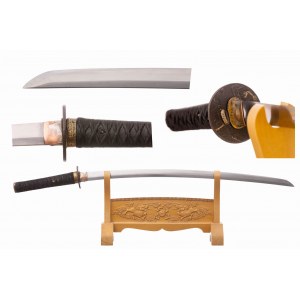
The head is hand-forged from Japanese tamahagane steel with high resistance to chipping and mechanical trauma. The blade is 66.8 cm long, of the shinogi zukuri type, selectively hardened with gunome-midare hamon. The layering pattern of the hade: ko-midare. The blade has a few delaminations (kizu) formed during the hand forging of the blade and proving the authenticity of the sword, a few scratches and corrosion marks, overall it is in decent condition. The sword dates back to the late 15th and early 16th centuries. The blade is attributed to the Uda school. The sword has a Japanese NBTHK Hozon certificate of authenticity confirming the above. It is light and handy (the sword weighs 1 kg). The blade has no armor (shavings, bo-hi), the wedge is attached to a single mekuga peg. The sword has a springy blade with good geometry. Habaki copper, silver-plated, smooth, copper seppa. Tsuba full, round steel, with a motif of a teaching sage, covered with a layer of patina with slightly rubbed gilding. Fuchi and kashira of iron, with gilded meander ornament. Menuki of brass with classical motif of shishi lions (temple guards). Scabbard (saya) wooden, made of magnolia wood, covered with shiny black lacquer with buffalo horn trim. Belt (sageo) of cotton in navy blue. Handle (tsuka) 21 cm long, wooden, clad in polished and black-painted stingray leather (same-gawa). The sheath (tsuka ito) made of Japanese cotton with a touch of silk in black and with a typical weave. The sword can be completely disassembled into individual pieces for maintenance or replacement. Maintenance treatments on all metal parts were performed on it (mainly cleaning and light polishing and corrosion protection). The handle, scabbard and tsuba were also fitted and selected, and the braid was preserved.