


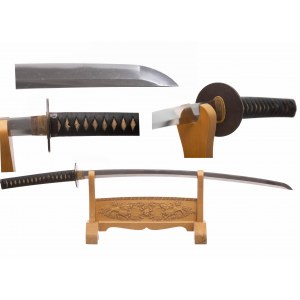
Blade forged by hand from Japanese tamahagane steel with high resistance to chipping and mechanical injury. The blade is 68 cm long, of the shinogi zukuri type, selectively hardened. As a result of the particular hardening process or the unique composition of the ore (or both), there was an interesting and rare pattern visible along the entire length of the sword: between the line of the hardening and the side protrusion of the shinogi, we can admire a second hamon, extending along the original, more visible suguha type hamon. This is the so-called nijuba hamon. The layering pattern of the hada is ita-me. The blade has several delaminations (kizu) formed during the hand forging of the blade and testify to the authenticity of the sword. The sword dates from the Muromachi era (15th century). The head is not signed.
The sword has a certificate from Polish appraiser Krzysztof Polak confirming the above details. It is light and handy (the sword weighs 1 kg). The blade has no armor (strudzina, bo-hi), the blade is fixed on a single mekuga peg. The sword has a springy blade with good geometry. Copper habaki, two-piece, with brass lining, once certainly gilded. Brass sepps. Tsuba of steel, round, forged, without decoration (remnants of already worn gilding can be seen), in a simple combat style. Fuchi and kashira made of shakudō, chiseled and partially gilded, decorated with images of birds and flowers, similar to menuki. Scabbard (saya) wooden, made of magnolia wood, covered with brown shiny lacquer with horn trim. Strap (sageo) of cotton in black. Handle (tsuka) 25 cm long, wooden, covered with natural stingray leather (same-gawa). Braid (tsuka ito) made of Japanese cotton with a touch of silk in black and with a typical weave. The sword can be completely disassembled into individual pieces for maintenance or replacement.
Blade length: 68 cm
Handle length: 25 cm
Dating: 15th century.








हाल ही में देखी गई
लॉट लिस्ट देखने के लिए कृपया लॉग इन करें
पसंदीदा
लॉट लिस्ट देखने के लिए कृपया लॉग इन करें