


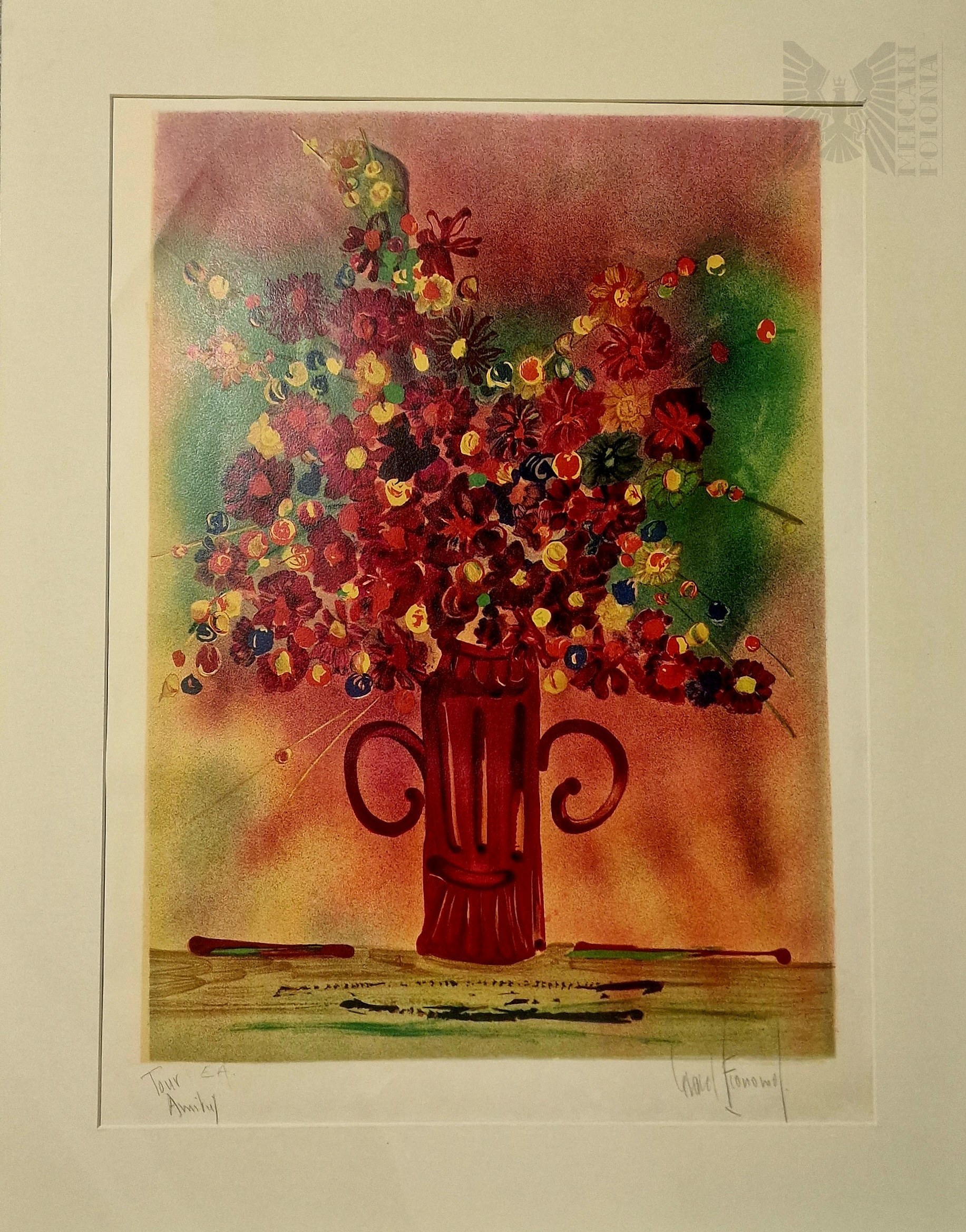
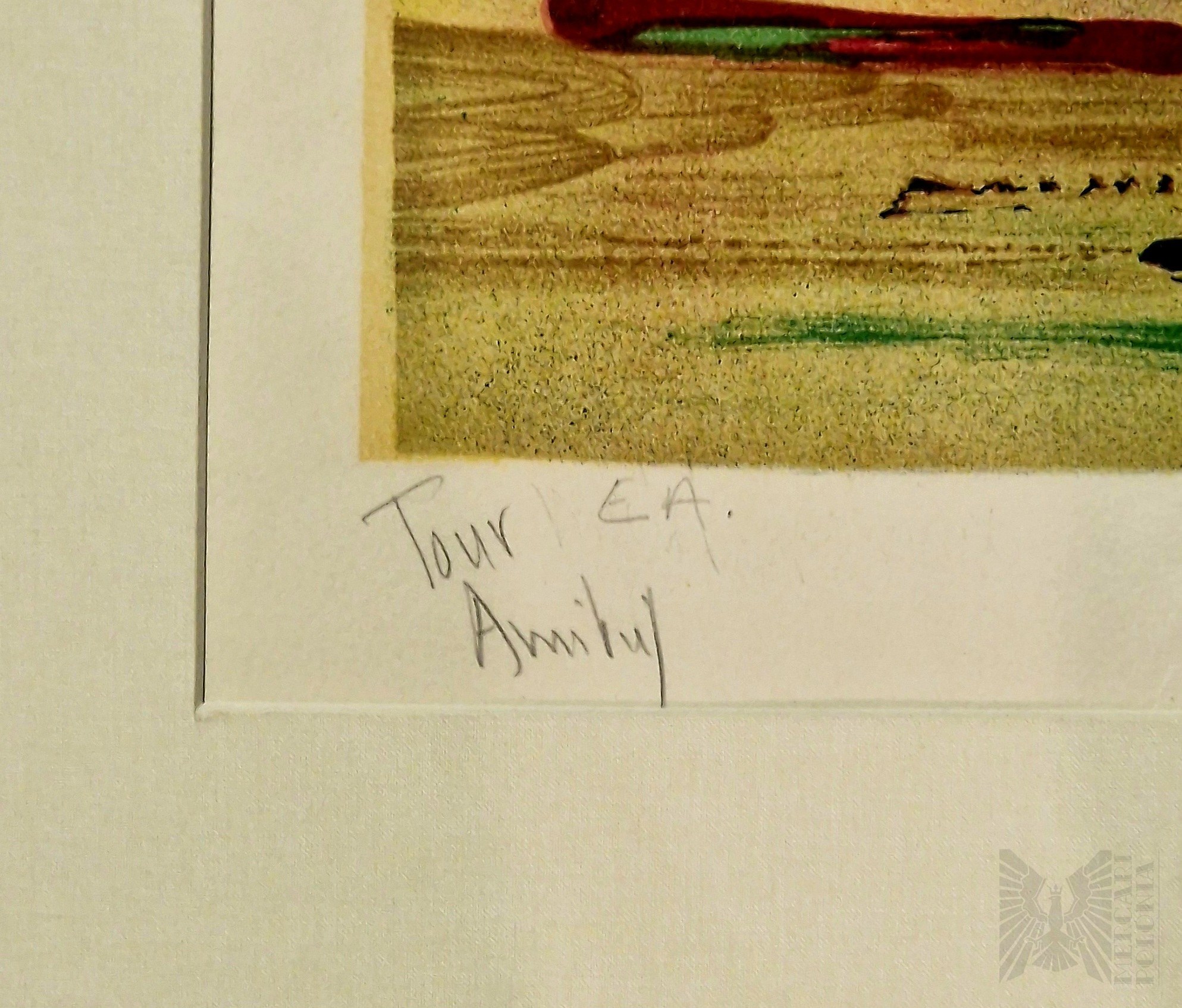
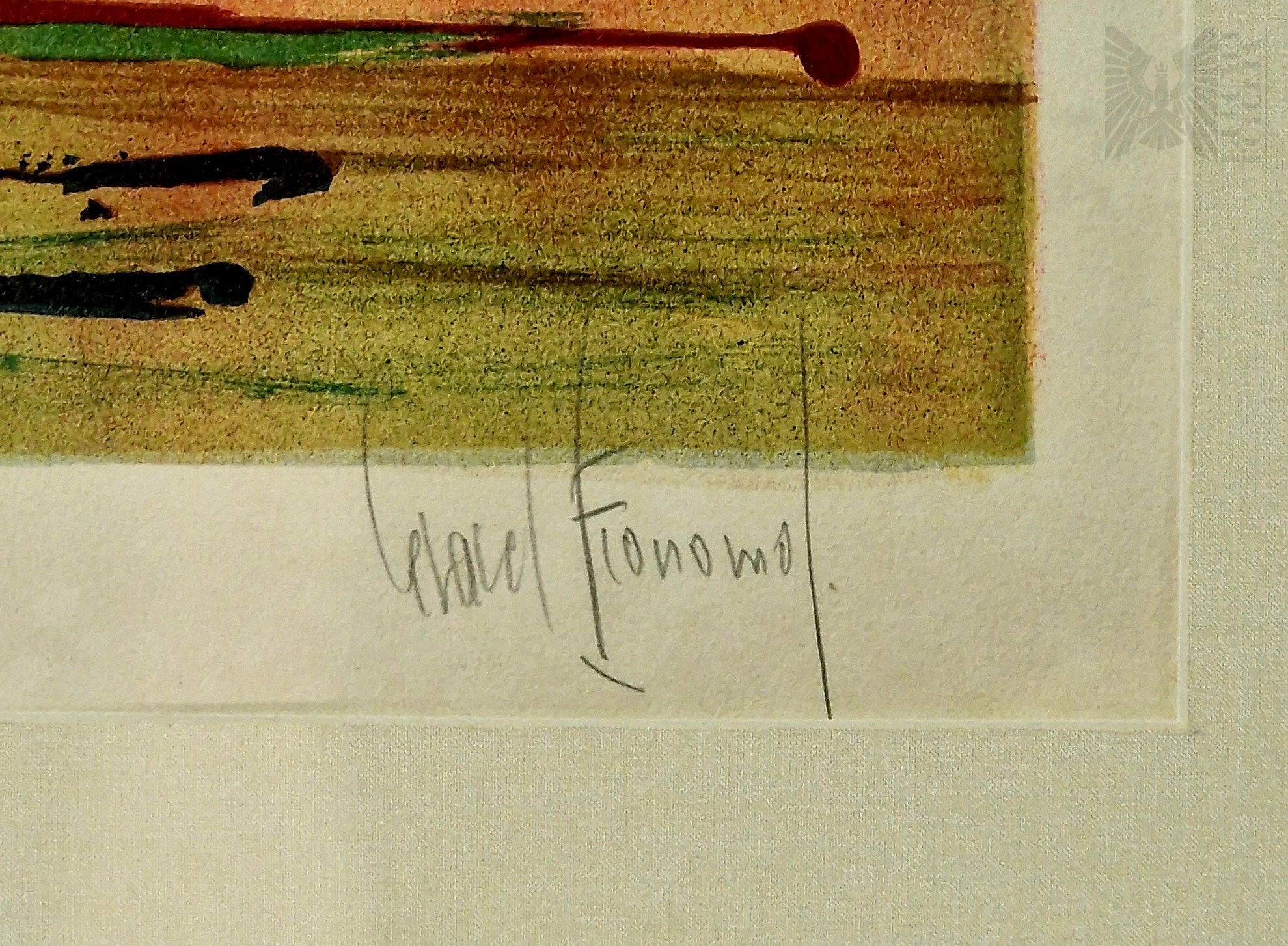
Silkscreen print; Arches France handmade paper, 100% cotton (Papier de Chiffon) with a very high basis weight and a distinctive “Torchon” texture; 66 x 50 cm inside the canvas mat, measuring 80 x 64 cm; signed in pencil by the artist at the bottom right, “Gérard Economos”; marked in pencil “EA” (Épreuve d'Artiste) and the dedication “Pour Amity.”
Publisher (Editeur): Vision Nouvelle, Paris
Printed by Atelier Arcay, Paris.
The Magic of Screen Printing (Serigraphy)—Unlike lithography, where ink is chemically “drawn” into the paper’s texture, in screen printing the ink is forced through a dense, usually silk, mesh. Each color requires a separate stencil and a subsequent layer of ink applied to the paper. In the luxury editions of the 1970s (especially those from Atelier Arcay), inks with a very high pigment and binder content were used, which gave the colors a “rich, full-bodied” effect. Producing such a richly saturated silkscreen required immense precision from the master screen printer to ensure that the design did not “bleed” when applying successive thick layers. Thanks to this texture, Economos’s work takes on the character of an almost unique oil painting.
Gérard Economos—born in Athens. Although his surname and origins are Greek, his artistic identity was fully shaped in France. He belonged to a generation of artists who came to Paris after World War I to create what we now call the École de Paris (Paris School). Economos became famous primarily as a painter and printmaker who worked with pure, joyful color. His style evolved from a fascination with Impressionism toward more simplified, almost Cubist forms, and in the 1960s and 1970s he focused on still lifes, landscapes, and architecture. He painted houses and small towns in a geometric style, yet always with a soft and warm touch. In his oil paintings, he used a technique of applying paint with a palette knife, creating almost sculptural surfaces. In printmaking (especially in silkscreen), he strove for the same effect. He wanted prints to be more than just “pictures on paper,” but physical objects with their own mass and texture.
The fact that his works were published by the luxury publisher Vision Nouvelle (alongside such luminaries as Miró and Dalí) attests to his high standing in the art market of the time. Vision Nouvelle operated a subscription system for the wealthiest collectors from around the world (particularly from Japan and the U.S.).
His works are held in the following collections:
- Athens Art Gallery (National Gallery – Alexandros Soutsos Museum)
- Musée d’Art Moderne de la Ville de Paris
- Musée de l’Annonciade (Saint-Tropez)
- Smithsonian American Art Museum
EA—“épreuve d’artiste” (artist’s proof)—means that a given print is part of a limited edition that is not included in the standard, numbered run. These types of prints are considered rare; their number is limited and, as a result, they are more expensive than the current print run. Prints marked EA are intended for the artist.








हाल ही में देखी गई
लॉट लिस्ट देखने के लिए कृपया लॉग इन करें
पसंदीदा
लॉट लिस्ट देखने के लिए कृपया लॉग इन करें