


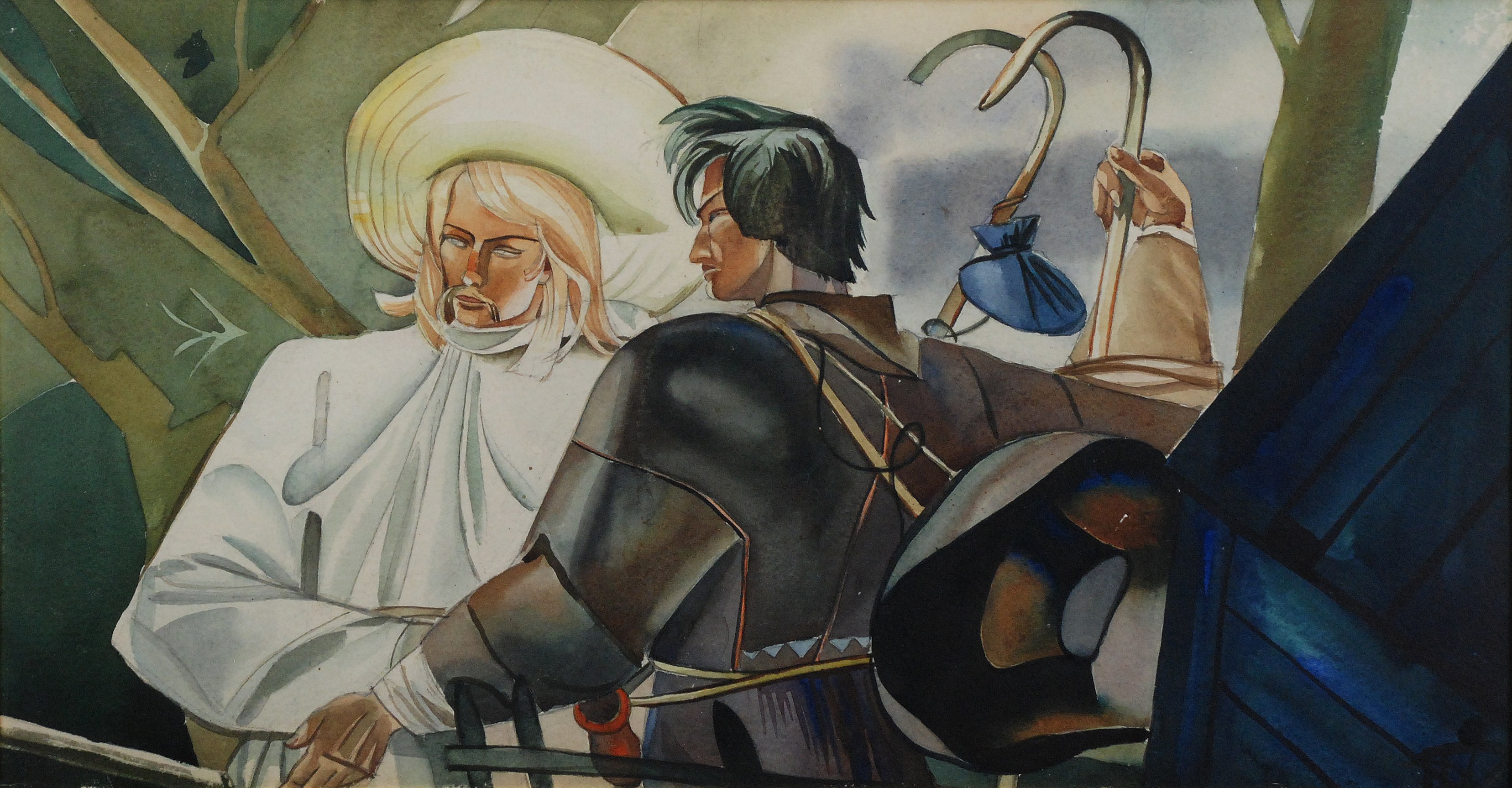
Watercolor, paper; 31 x 60 cm;
Exhibition at the National Museum in Krakow. October 2008 - January 2009, Cracow 2008 - III.I.33; p. 317.
The motif, reversed by sides, is an almost identical repetition of a fragment of the composition "Piast" ("Angels at Piast's") from 1935. [gouache, paper pasted on plywood, National Museum in Cracow, inv. no. II-b-19; cf. Catalogue M.N.K. - III.I.32; p. 317].
The presented work by Zofia Stryjeńska is another important painting after the work "Baptism" from the series "Seven Sacraments," as pointed out by Swiatoslaw Lenartowicz of the National Museum in Cracow. "Wanderers" is a fragment of the composition, in mirror image, in the collection of the National Museum in Krakow, "Piast" ("Angels at Piast") dated between 1932-1936 and constituting the first acquisition, among Zofia Stryjeńska's works, to the collection of the Krakow museum.
In the catalog of the 1935 exhibition "Exhibition of Zofia Stryjeńska, a collection of paintings titled Black Silesia by Rafal Malczewski, Al. Jędrzejewski, Efroim and Menashe Seidenbeutl, the Group of Artists of the Painters' Lodge", one can find two items documenting the painter's interest in the genesis of the creation of the Polish state, or in the messages pointing to the origin of the first dynasty of Polish rulers. These items are the 9th "Piast" and 10th "Wanderers." In 1929, by Jakub Mortkowicz, a portfolio "Piasts" was also published by a Krakow artist, containing 22 boards with images of the rulers.
The featured painting is a painterly interpretation of Gall Anonymus' account of when two wanderers were invited to a ceremony for the shoeing of a Piast son and gave him a blessing, at the same time performing a miracle involving the non-exhaustion of food supplies. In later legends - such as those from the 14th-century Dzierzwa Chronicle - the wanderers are already referred to as angels, and according to Marcin Bielski's account, Piast's profession changes from humble plowman to wheelwright. There is also no clear consensus among the authors of the legend who became the first ruler, Piast or his son Siemowit [Ziemowit].
The artist characteristically immortalized folk customs, scenes from village life or Slavic messages in her paintings and prints. She constructed the space of the sub-painting from defined, slightly geometrized color patches of distinctive hues, which can be considered a transposition of her experience with Cubist painting.
One of the key moments in Zofia Stryjeńska's work was when she received the grand prix in 1925 at the International Exhibition of Decorative Arts in Paris. At the same time, this is the time when the art déco style was exceptionally popular and, although it is mainly associated with applied art in the broadest sense, its formal elements can also be found in Zofia Stryjeńska's paintings. It is worth mentioning that the artist was also involved in designing scenography, illustrations, textiles or even toys, which probably also allowed the influences of the trends of the time from different fields of art to freely permeate each other and gave the opportunity to create a unique set of features common to her work.










हाल ही में देखी गई
लॉट लिस्ट देखने के लिए कृपया लॉग इन करें
पसंदीदा
लॉट लिस्ट देखने के लिए कृपया लॉग इन करें