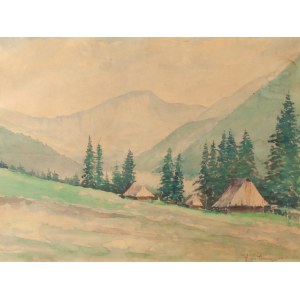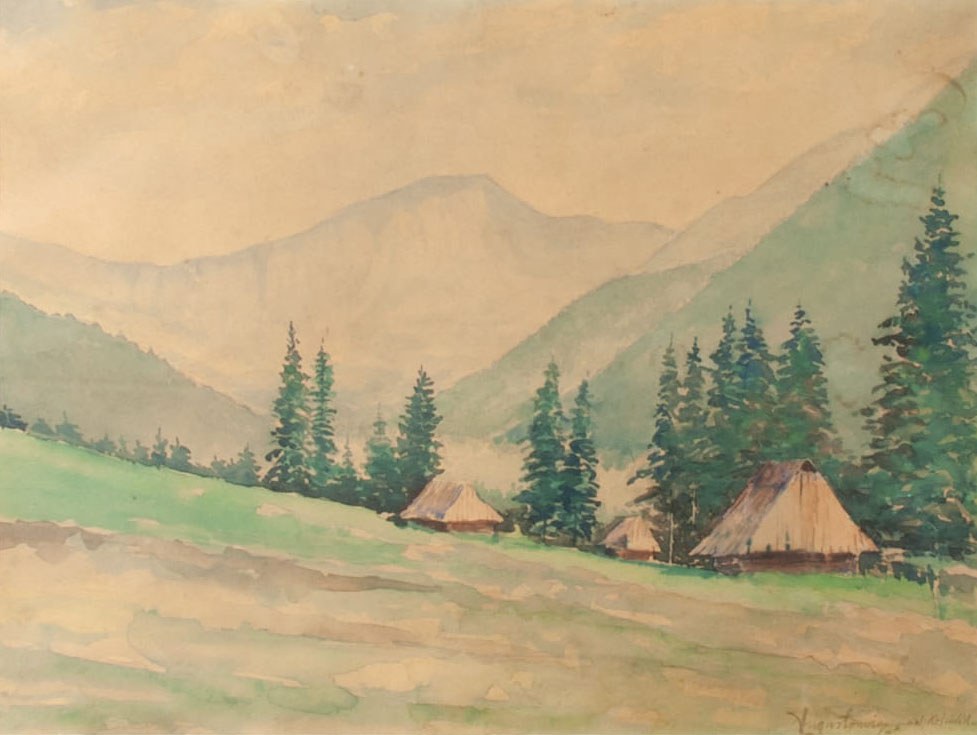
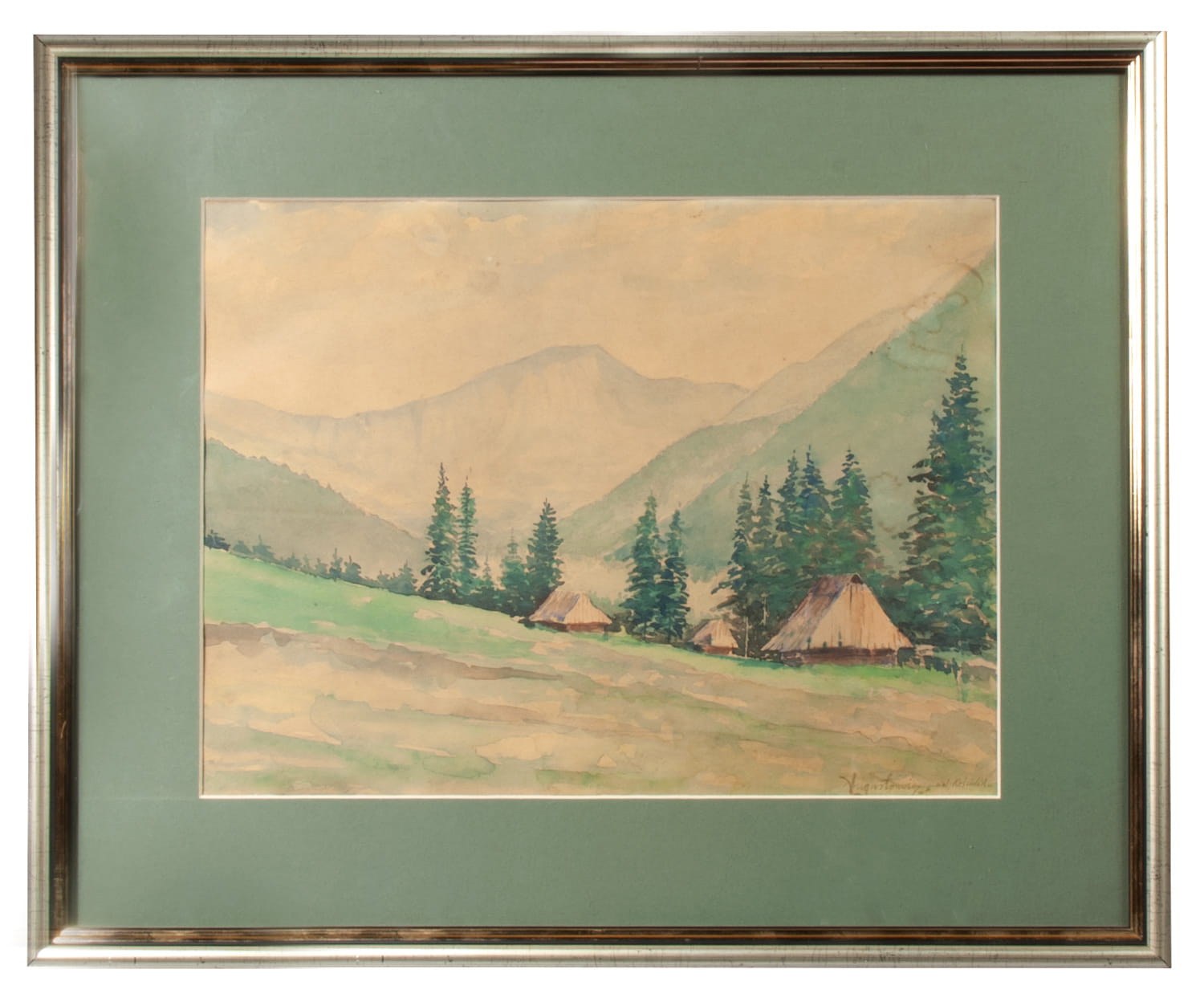
Watercolor on paper, signed and inscribed in the lower right: “Augustynowicz dol. Kościeliska.”
Dimensions in frame: 37.5 x 45.5 cm (24 x 32 cm)
Aleksander Augustynowicz (Iskrzynia 1865–1944 Warsaw)—Polish painter, portraitist, and landscape artist. He attended middle school in Rzeszów; subsequently, from 1883 to 1886, he studied under Feliks Szynalewski, Władysław Łuszczkiewicz, and Jan Matejko at the School of Fine Arts in Kraków. After completing his studies in Kraków, he went to Munich to continue his education and also undertook artistic journeys to Italy and Hungary. From 1890, he lived in Lviv, where he began his artistic career. After the outbreak of World War I, he moved to Zakopane, where he lived from 1914 to 1921. He then moved permanently to Poznań, where he had already been exhibiting his works at the Artists’ Association during the war. In 1925, he became a member of the Committee of the Society for the Encouragement of Fine Arts in Warsaw; that same year, he received the highest honorary award for his lifetime achievement. In 1936, he celebrated the fiftieth anniversary of his artistic career in Poznań, which included a major retrospective exhibition of his works. On November 11, 1937, “for his contributions to the arts,” he was awarded the Officer’s Cross of the Order of Polonia Restituta by Polish President Ignacy Mościcki. After the outbreak of World War II, he moved to Warsaw, where he died during the Warsaw Uprising. He painted figurative compositions, and above all, portraits; in Poznań, he painted portraits of, among others, Wojciech Trąmpczyński, Ignacy Mościcki, and Witold Celichowski; it was also there that he created most of his watercolors. Watercolors dominated the later period of his career, particularly those depicting landscapes and Polish folklore. Augustynowicz’s paintings enjoyed great popularity, and his works can be found in many Polish museums and private collections. The National Museum in Poznań has 14 oil paintings and watercolors in its collection, including a self-portrait in mandarin attire.