


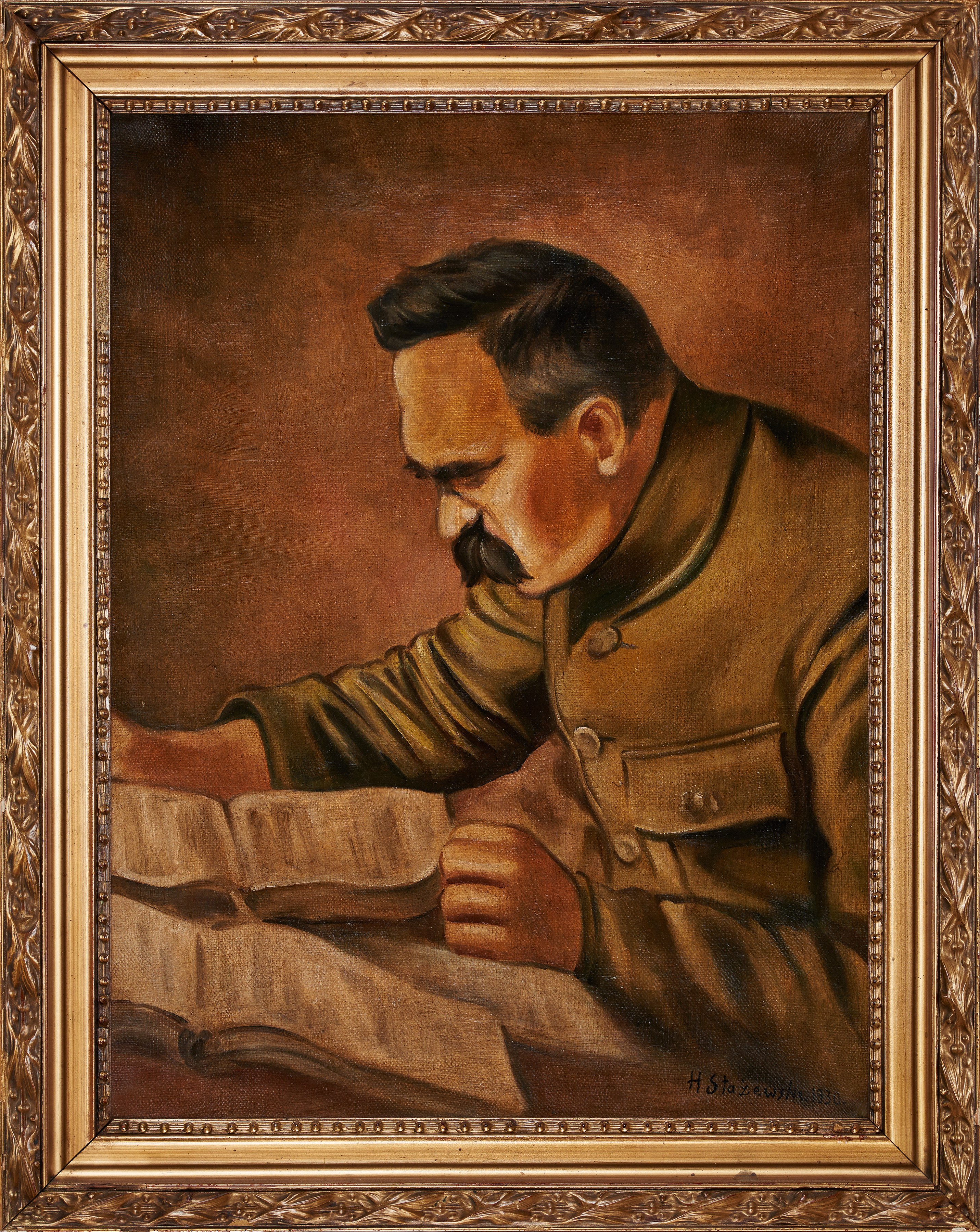
oil, canvas / 50 x 38cm [clear frame].
59 x 47 cm, dimensions with frame
signature and date p.d.: 'H Stażewski 1930'
on the reverse side a label with the date 1939
inventory number: UK/et/12/5/2020/e
ORIGIN:
private collection
Henryk Stażewski, painter, pioneer of the avant-garde of the 1920s and 1930s, representative of constructivism, co-founder of the geometric abstraction trend of the 1960s, 1970s and 1980s. Author of relief compositions, designer of interiors, stage decorations and posters. Born January 9, 1894 in Warsaw, died there June 10, 1988.
He studied art from 1913-1919 at the Warsaw School of Fine Arts in the studio of Stanislaw Lentz. He was associated with the first Polish avant-garde group founded in 1917, called Polish Expressionists, and renamed Formists in 1919. He made his debut in 1920, showing his works together with the Formists at the Warsaw Society for the Encouragement of Fine Arts. In 1921 he presented his paintings with Mieczyslaw Szczuka at the avant-garde Polish Art Club. In 1922 he took part in the F 9 Formists' exhibition at Czesław Garliński's Salon in Warsaw. In 1923, he participated in the Exhibition of New Art in Vilnius and the International Exhibition of New Art in Lodz, both of which initiated the Constructivist movement in Poland. He was a founding member of the Group of Cubists, Constructivists and Suprematists "Blok" (1924-1926), as well as the groupings that expanded the programmatic assumptions of Blok - Praesens (1926-29) and a.r. (1929-1936); he also edited the magazines "Blok" and "Praesens".
From 1923 he designed interiors and theater decorations. He presented his avant-garde works at the Automobile Salon of the Laurin and Klement company in Warsaw. Starting in 1924, he repeatedly stayed in Paris, where he established close contacts with Piet Mondrian and Michel Seuphor. He made a significant contribution to the history of the world avant-garde with his artistic and theoretical and journalistic activities. He belonged to the international groups Cercle et Carre (since 1929) and Abstraction-Création (since 1931), which were constituted in Paris.
From 1926 he represented Polish art abroad in exhibitions organized by the Society for the Propagation of Polish Art Among Foreigners. In 1928, he made cover designs for the magazine "MUBA" edited in Paris by the Lithuanian poet Juozas Tysliava. In 1929, also in Paris, he collaborated with Jan Brzękowski and Wanda Chodasiewicz-Grabowska on the publication of the magazine "L'Art Contemporain - Contemporary Art." He participated in many international exhibitions, including the "1st International Exhibition of Modern Architecture" (Warsaw, 1926), "Exhibition of Theater Art" (Paris, 1926), "Machine Age Exposition" (New York, 1927) and "Konstruktivisten" (Basel, 1937).
In 1932 he presented his work with the New Generation group at the Lviv Society of Friends of Fine Arts and the Lodz branch of the Institute of Art Propaganda, while in 1935 he joined the Krakow Group exhibition in Krakow. He was among the founders of the International Collection of Modern Art opened to the public at the Museum of Art in Lodz in 1931; the collection included works by H. Arp, M. Seuphor, T. van Doesburg, F. Legér, M. Ernst, A. Ozenfant and E. Prampolini. In 1933, he became a co-founder of the Circle of Advertising Graphic Artists, being the author of a number of typographic designs with a style akin to Neoplasticism. That year saw the first individual exhibition of the artist's works combined with a presentation of Karol Krynski's works at the Institute of Art Propaganda in Warsaw. During World War II, almost all of Stażewski's artistic output was destroyed.
After the war, the artist became associated with the Club of Young Artists and Scientists and the avant-garde Krzywe Koło Gallery in Warsaw. The artist presented his works at many exhibitions of Polish contemporary art abroad, including. In Paris (Musèe d'Art Moderne, 1977, 1982; Centre Georges Pompidou, 1983), Stockholm, Amsterdam, Brussels and Geneva (1959), Venice (1959, 1966, 1986), New York (Museum of Modern Art, 1976), Oslo (1961), Essen (1962, 1973), Stuttgart (1962), Chicago (1964, 1966, 1967, 1972), Bochum (1964), Tel-Aviv (1965), Tokyo (1966), London (Royal Academy, 1970, 1984), Strasbourg (1970), Düsseldorf (1974, 1981, 1982), Milan (1974, 1986), Zurich (1974, 1975), Hamburg (1975), Madrid, Berlin and Cologne (1977), Rome (1979) and Los Angeles (1981). A retrospective exhibition of Stażewski's art was organized in 1994 at the Museum of Art in Lodz. At the XXXIII Biennale held in Venice in 1966, the artist received an honorary mention, while in 1972 he won the Gottfried von Herder Prize awarded by the University of Vienna.
In the early 1930s, a figurative current crystallized in the artist's work, which continued to develop until the 1950s; it abounded in landscapes, portraits and still lifes. Stażewski's formally very diverse art of the 1960s and 1970s was completely within the framework of geometric abstraction. In the second half of the 1950s, the artist introduced a new element into his artistic language - relief, which displaced purely painterly media for almost twenty years.
In 1968, the tendency to subject artwork to the objective laws of science intensified. The basic module in the works of this period became a colored square, which the artist multiplied, varying its color slightly to achieve a multiplication of dimensions and intensification of chromatic effects. In addition to easel painting, the artist did mural painting, was involved in applied graphics and typography, and did interior design, stage design, posters and ceramics [based on a study by Irena Kossowska of the Institute of Art of the Polish Academy of Sciences].





हाल ही में देखी गई
लॉट लिस्ट देखने के लिए कृपया लॉग इन करें
पसंदीदा
लॉट लिस्ट देखने के लिए कृपया लॉग इन करें