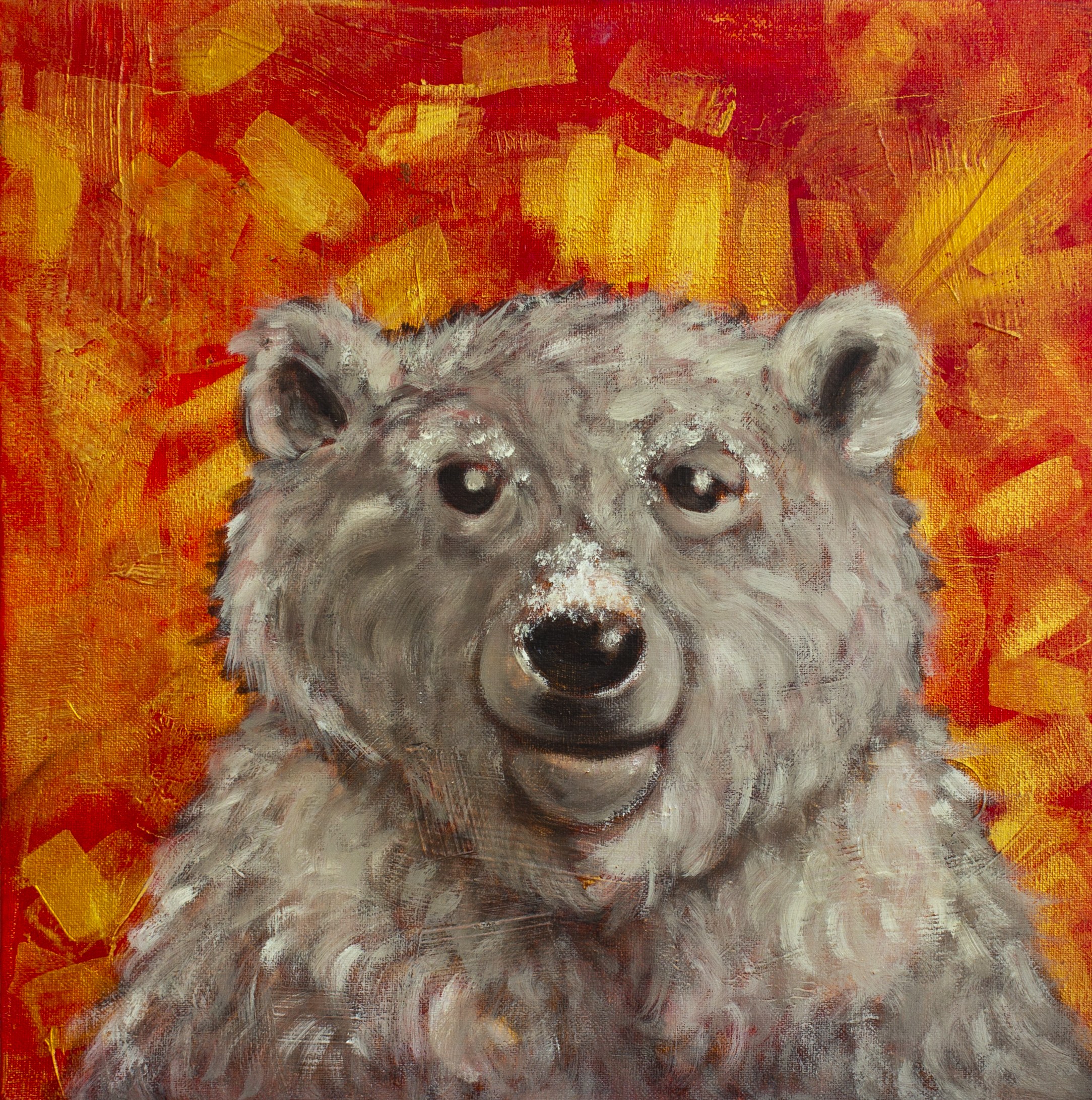
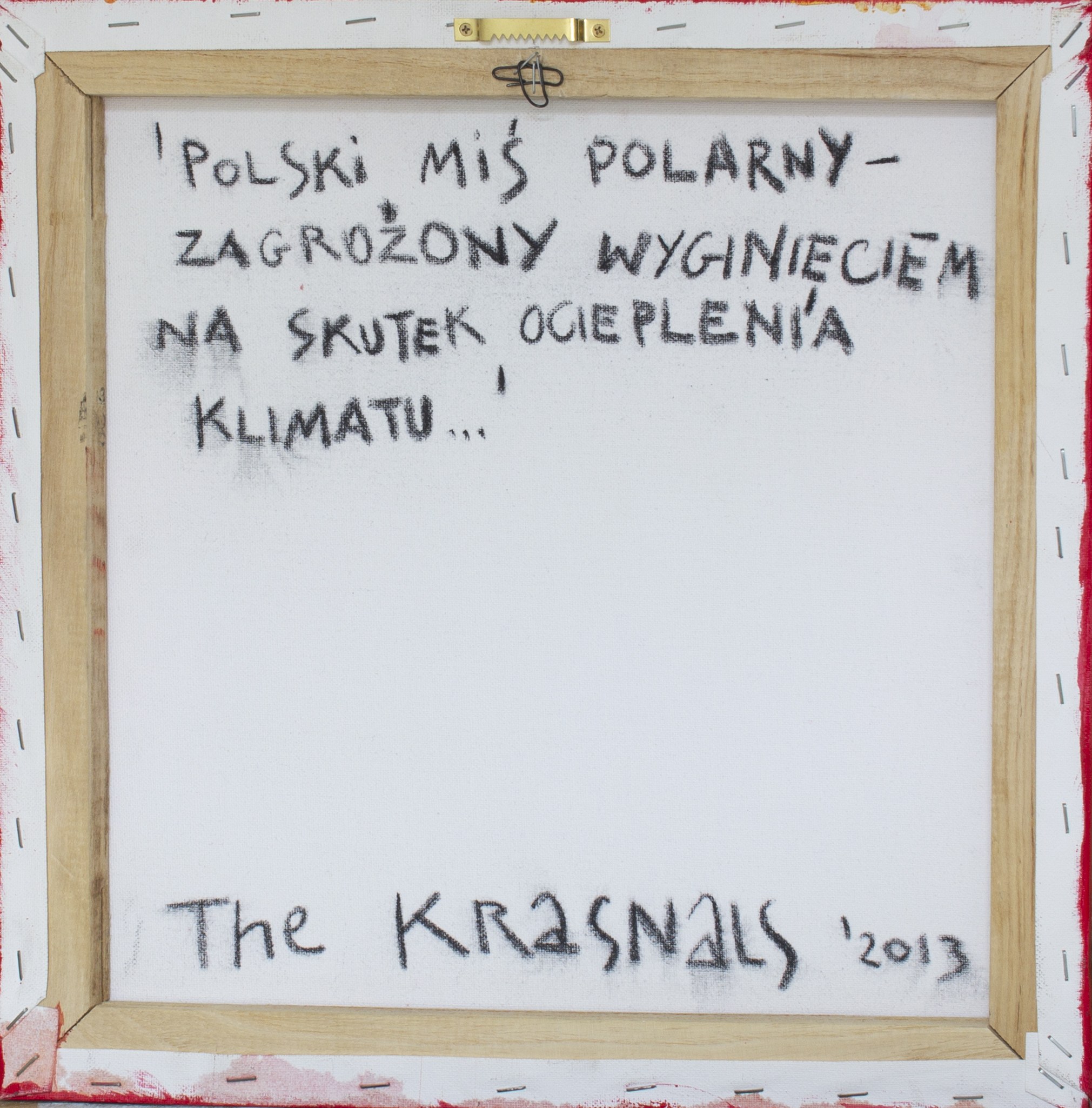
oil on canvas, 40 x 40 cm, signed on the reverse 'POLSKI POLAR BEAR - | ENDANGERED WITH EXTINCTION | AT THE EFFECT OF THE COOLING | CLIMATE...' | THE KRASNALS '2013'.
Work presented at the exhibition "Autportrait of Polish Reality", Upper Silesian Museum in Bytom, 2023/2024 and is reproduced in the catalog.
Anonymous collective The Krasnals, formed on April 1, 2008, is one of the most ambiguous and provocative art groups in contemporary Poland. From the beginning, their activity has been critical in nature - targeting both the mechanisms of the art market and the social and political contexts that co-create this market. Neo-Dadaist in spirit, they combine humor with sharp sarcasm, and derision with an accurate diagnosis of modernity.
The Krasnals point out the hypocritical manipulations and mechanisms of promotion, expose the backstage of artistic careers and expose the way the system works, in which the artist becomes a brand. With characteristic uncompromisingness, they "knock down from their pedestals" self-appointed authorities, often using quotation and appropriation. Their practice has a dimension of artistic cannibalism - creative parasitism on cultural icons, from which provocative compilations full of meaningful tensions are created.
In their paintings, they often draw on the stylistics of Wilhelm Sasnal, which is also a form of criticism of the phenomenon of commercialization of art. Their work grows out of the tenets of neo-Dadaism - full of sarcasm, consciously balancing between art and social commentary, they encourage distance and self-reflection.
The Krasnals are eager to reinterpret classic works, transforming them into a cutting edge of satire. Their monumental "Battle of Grunwald" is both a pastiche of Matejko and a critique of national myths. In this ironic gesture, the artists expose the need to confront their own history and the mythology of the "sacred images" of Polish culture. They engage in a similar dialogue with literature - in a series inspired by Bruno Schulz, they juxtapose his oneiric, metaphysical world with the brutal literalism of contemporary art world, showing how fragile the line between artistic dream and market reality is.
The group is also known for its presence at prestigious international events - including at Tate Modern during the Pop Life exhibition (2009). Their works also went to auction at Christie's, which The Krasnals took with irony as proof that even a gesture of criticism of the system gets absorbed by the system.
In 2011, they participated in the 54th Venice Art Biennale, and set up their para-pavilion "Kingdom of The Dwarves" ("The Kingdom of The Krasnals") in the central part of the Giardini. Their actions - such as the slogan "Make Love Not Art" and the distribution of their own "Art Police Gazette" - were primarily symbolic: they were an objection to the elitism and marketing environment of international art institutions.
Over time, the work of The Krasnals also found its way into institutional spaces. Their works have been presented in museums and galleries throughout Poland, including the National Museum in Krakow MOCAK, the Zachęta Gallery in Warsaw, the Upper Silesian Museum in Bytom, the CCA in Warsaw and Toruń, as well as in numerous regional centers. They are shown both in solo exhibitions and in the context of broad reviews of contemporary art, where their voice remains one of the most distinctive and unruly.
The work of The Krasnals is a constant game with the viewer - full of irony, self-analysis and provocation. At its center is the question of authenticity in a world dominated by appearances, prestige and money. Under the mask of humor and scandal, the group reveals what is most essential in art - the constant need for freedom and the courage to think against the established rules.