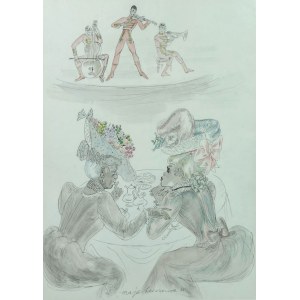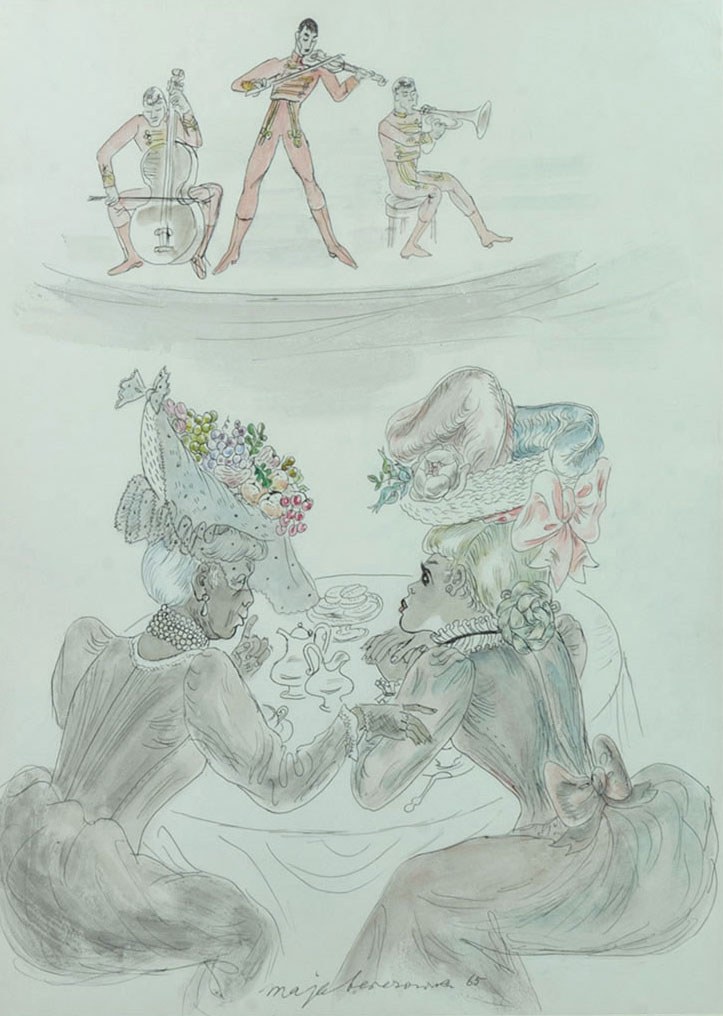
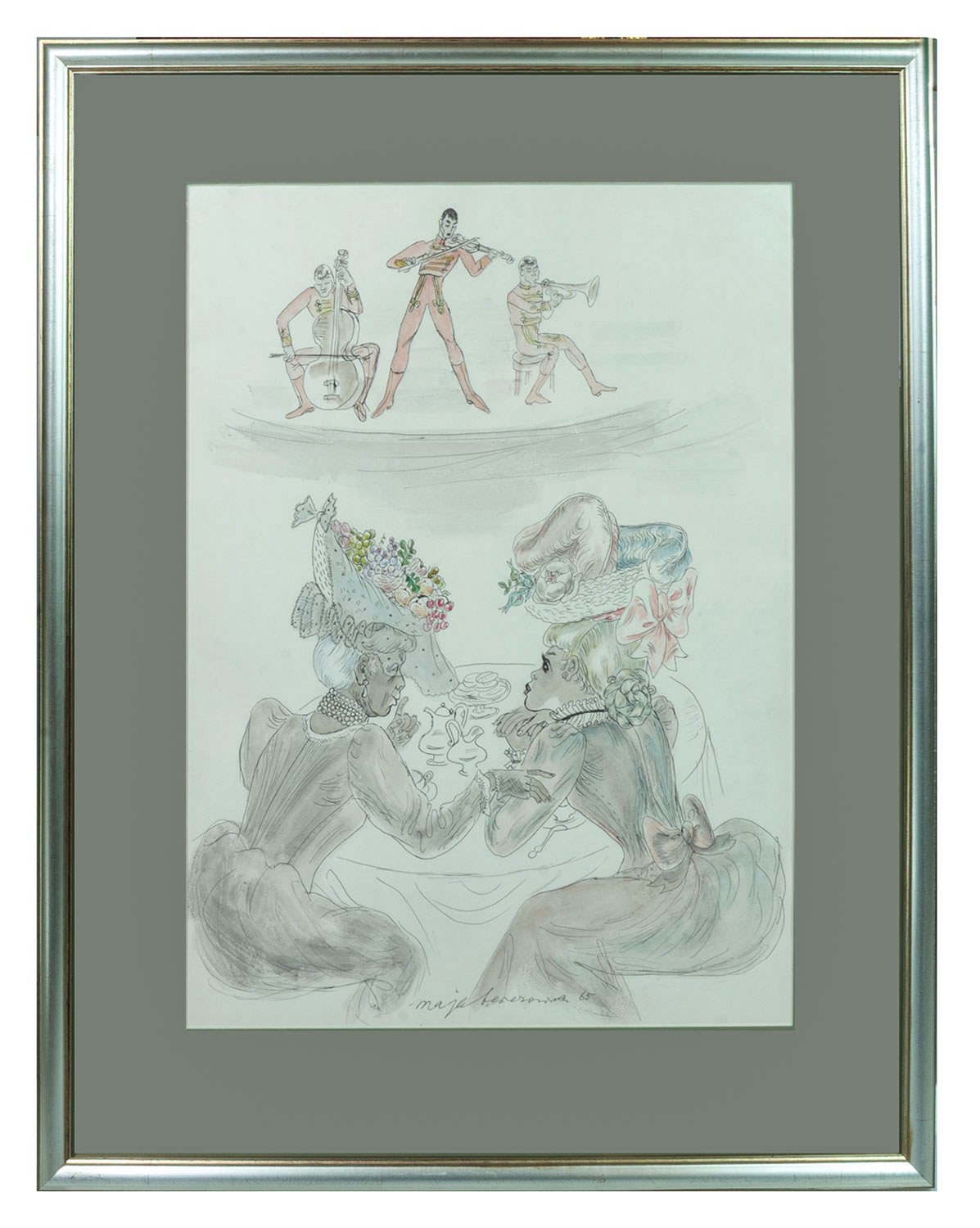
Watercolor, ink on paper, signed at bottom: "maya berezowska 65"
Dimensions in frame: 68x53 cm (50x36 cm)
Maja Berezowska, or Maria Berezowska, alias "Ditto" (Baranowicze 1892 or 1893 - 1978 Warsaw) - Polish painter, graphic artist, caricaturist and stage designer. She studied at a private art school in St. Petersburg (1908-1909), and studied at art colleges in Krakow (1910-1912) and Munich (1913). Since 1918 she was married to painter, caricaturist and stage designer Kazimierz Grus, whom she divorced around 1926. Already before the war, she gained fame as the author of subtle graphics with erotic themes. The sublimity of human feelings and the amorous act were constant motifs in her work throughout her life. The 1956 publication of Jan Sztaudynger's Feathers with her illustrations, at the time morally daring, was one of the symptoms of the political thaw and the coming changes. The artist's first solo exhibition took place in Kyiv in 1916, and by 1939 her caricatures, drawings and illustrations were published by widely read satirical weeklies: "Cyrulik Warszawski", "Szpilki", or "Szczutek", published in Lviv. Her works were also presented by "Theater," "New Culture" and "Przekrój," among others.During the communist era, she also illustrated more than a dozen books. Her first professional contact with the stage was co-creating the visual setting for performances of the literary and artistic cabaret "Czwórka" in Lviv in 1919. In the 1930s, she designed costumes for, among others, Zula Pogorzelska and Hanka Ordonówna, as well as operettas and cabarets (in Warsaw and Poznan). After returning from Paris, she was a full-time stage designer for the "Theater of 13 Rows" cabaret in the 1936/1937 season. After the war, stage design and costume design became her main occupation. She worked for: Lodz Opera and many Warsaw theaters. From 1933 to 1936 she lived in Paris, collaborating as a cartoonist and caricaturist with magazines "Le Figaro", "Le Rire", "Ici Paris". In 1935, Berezowska published a series of caricatures entitled Sweet Adolf's Pleasures, concerning Hitler. Shortly after the publication of this issue of the newspaper, the German embassy in Paris filed an official action against Berezowska, proving that the drawings were a punishable insult to the head of state. The fine sentence awarded by the first instance (500 francs), was appealed by Sarrault, who made a fiery speech before the appellate court, arguing, among other things, that "it is a disgrace to the Ville Lumiere! In a city of artists to condemn an artist for her work!". The fine was reduced to a symbolic amount. Defeat before the French court, the Nazis made amends after the war began. In January 1942, as a result of a denunciation, she was captured by the Gestapo and imprisoned in the Pawiak prison. In May of that year, she was officially imprisoned in Ravensbrück concentration camp for insulting Hitler, with a death sentence. At Ravensbrück, she continued to create as much as possible. She made portraits of fellow inmates and captured scenes of camp life, puppets and costumes for actors for the camp's Christmas nativity scenes. After the liberation of the camp by Soviet troops, she and a group of Polish women left Ravensbrück for Stockholm in May 1945, for rehabilitation organized by the Swedish Red Cross. She exhibited the works she created during this period in Sweden and Denmark. She returned to Poland in June 1946.