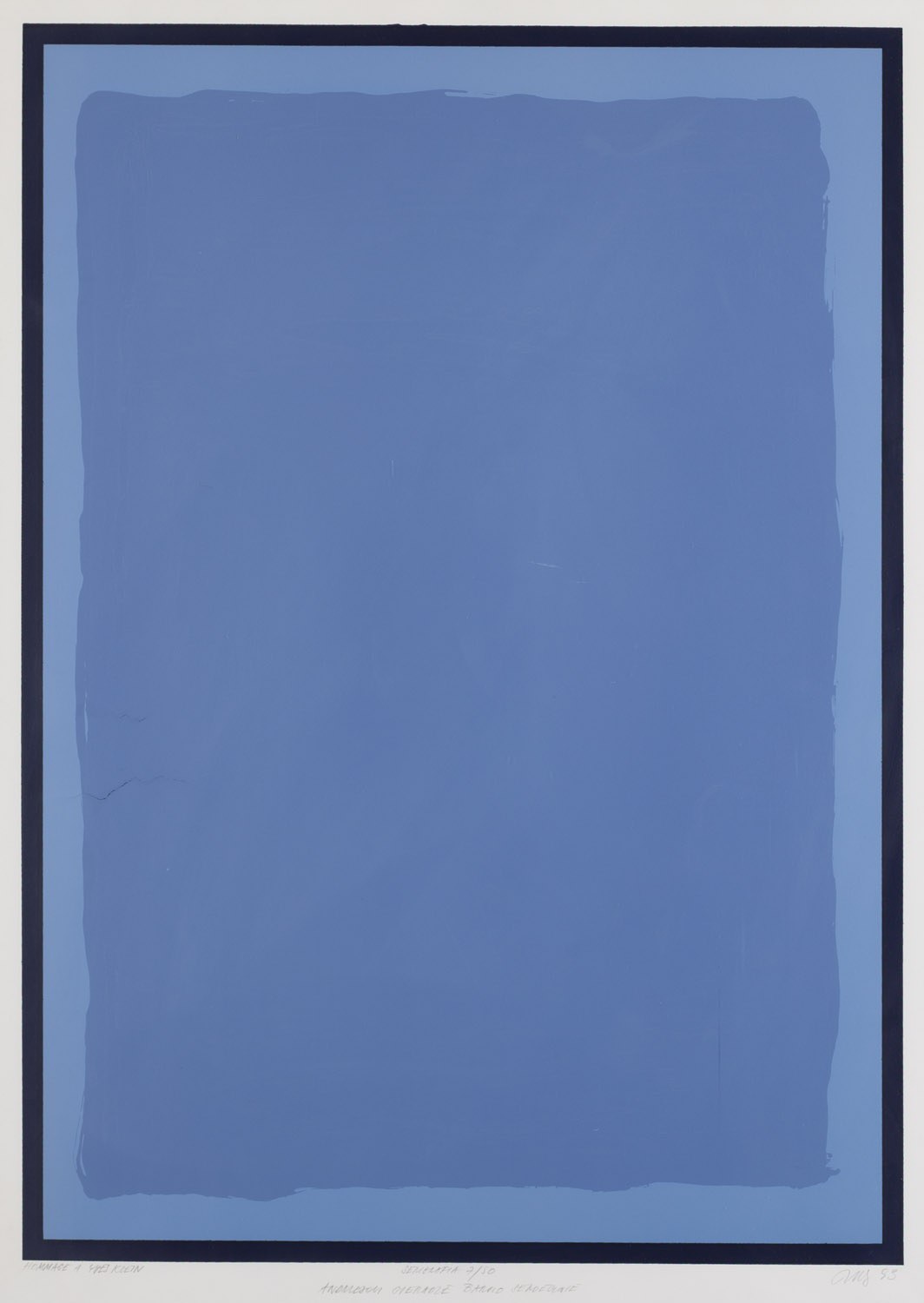



Dimensions: 70 x 49.5 cm (print)
signed, dated, and inscribed in pencil at the bottom: 'HOMMAGE A YVES KLEIN SERIGRAPHY 7/50 [artist’s signature] 93 | [artist’s dedication]'
ed. 7/50
Condition
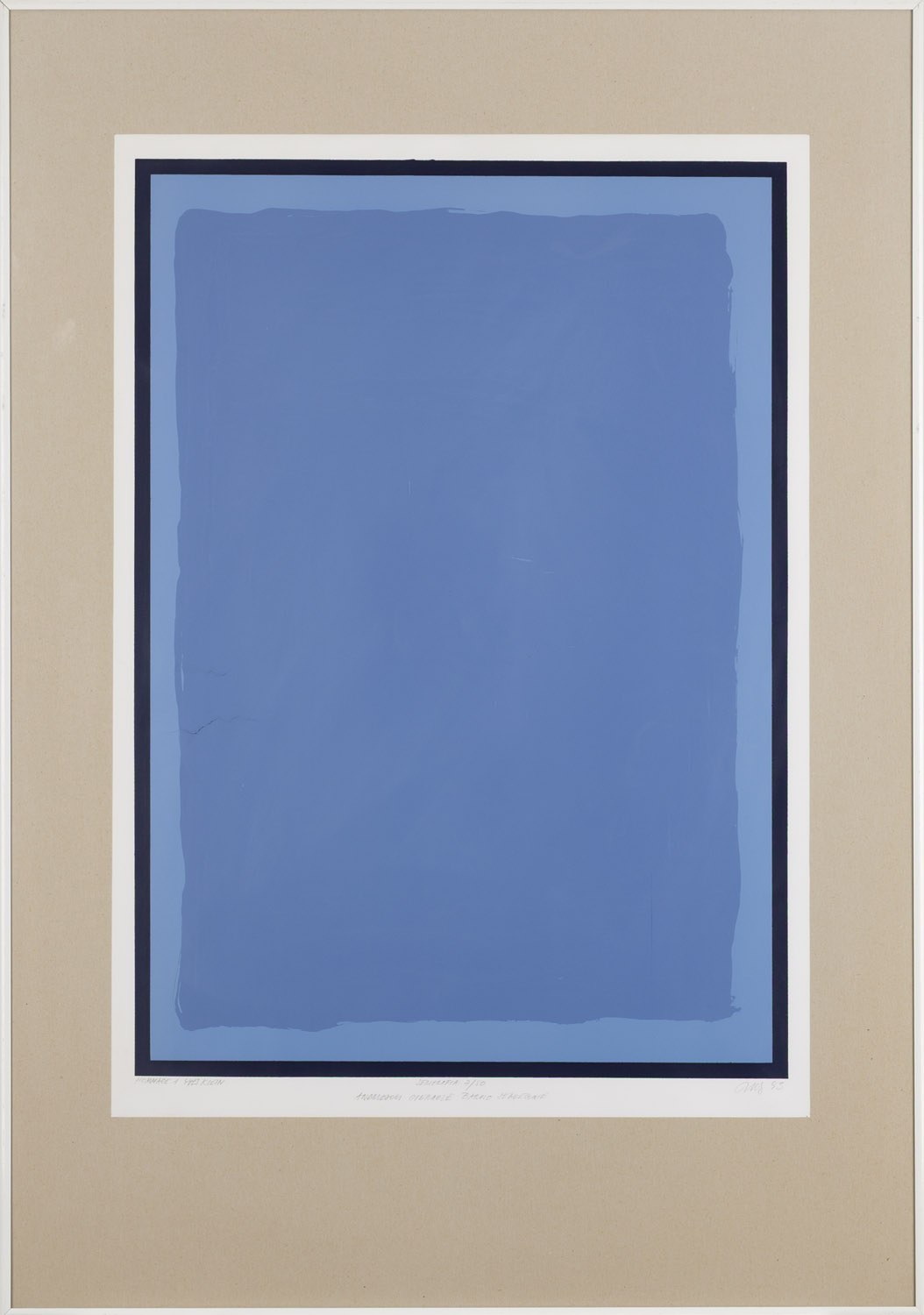
Work mounted
Three creases are visible on the surface of the work; within two of the creases near the left edge of the composition, localized cracking of the paint layer is visible, caused by the folding of the support.
Biography
Painter and educator, associated with Łódź. A graduate of the State Higher School of Fine Arts in Łódź (now the Władysław Strzemiński Academy of Fine Arts), where he earned his diploma with honors from the Department of Fashion Design in 1970. He studied painting in Zdzisław Głowacki’s studio. Starting in 1971, he taught at his alma mater, where he served, among other roles, as associate dean of the Faculty of Graphic Arts (1981–1984), and in 1992 he was awarded the title of full professor of fine arts. He also taught at the Film, Television, and Theater School (PWSFTviT) in Łódź and at the Faculty of Radio and Television at the University of Silesia in Katowice.
He was involved not only in painting but also in graphic arts, costume design, exhibition design, and set design—he collaborated with film studios (including on the film *The Duchess Anna’s Ring*), theaters, and museums. He received numerous awards for his teaching. He was a fellow of the prestigious Pollock-Krasner Foundation in New York.
He has held numerous solo exhibitions, including in Łódź, Warsaw, Wrocław, Bonn, Cologne, and New Delhi. His works are held in public collections, including the Museum of Art in Łódź, the National Museum in Warsaw, the Ludwig Museum in Cologne, The Pollock-Krasner Foundation in New York, and the Center for Contemporary Art (CSW) Ujazdowski Castle in Warsaw.
Color—intense, pure, and often contrasting—is at the heart of his painting. Bigoszewski built his compositions around signs and geometric forms—squares, rectangles, and outlines resembling the shadow of a human silhouette. The layering of colors and forms created a space with an illusion of depth, organizing the image according to a strictly defined hierarchy and rhythm. The artist’s paintings transcended traditional two-dimensionality—he treated the canvas as a three-dimensional object, incorporating the frame and edges into the composition as well. His works are characterized by clarity, formal discipline, and a strong emotional charge, expressed through intense color and the structure of the painting.