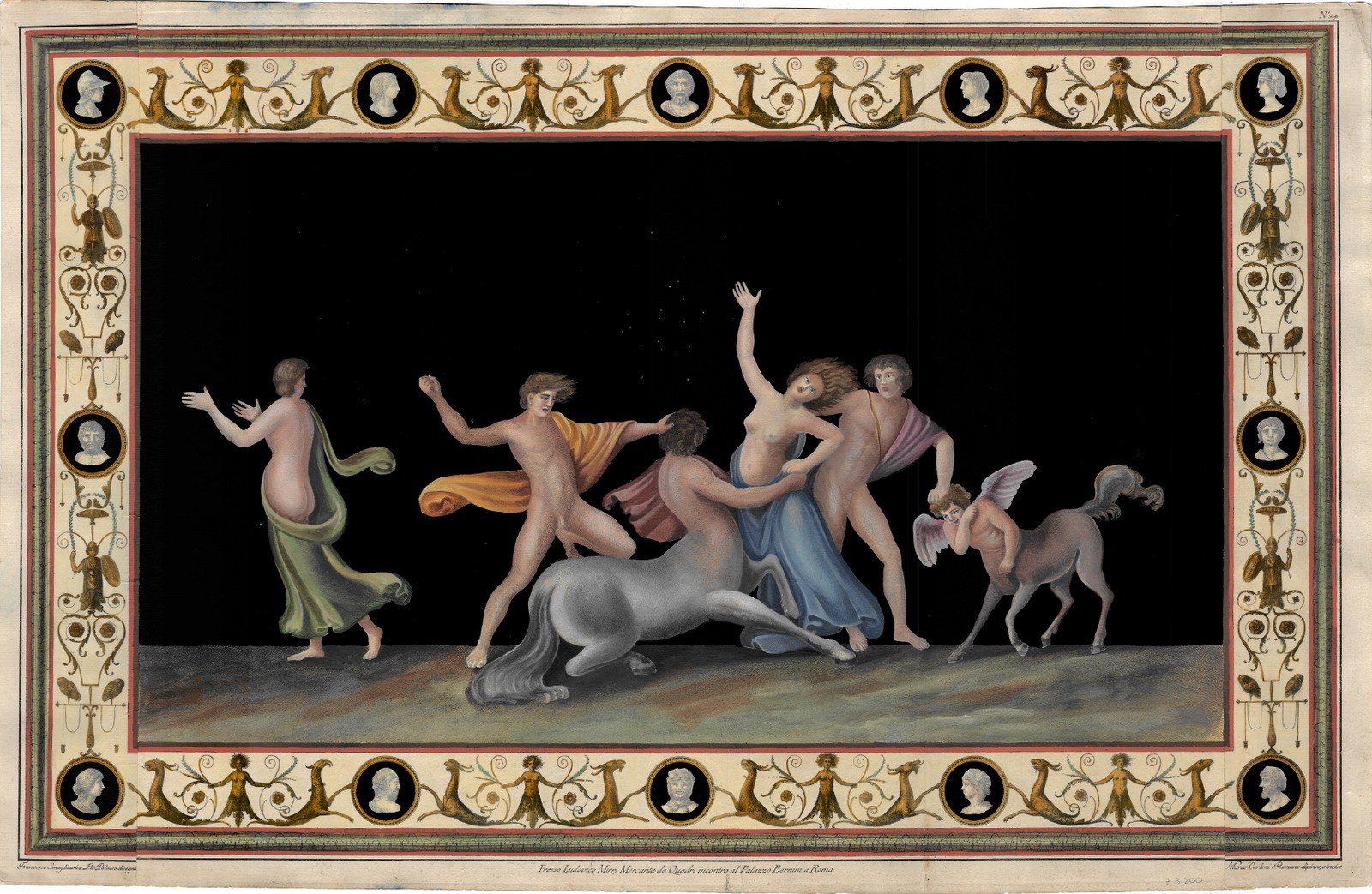
Franciscus Smuglevičius (1745-1807)
The Kidnapping of Hippodamia, from the fresco album of Nero's Golden Palace (erroneously called the Baths of Titus) by Lodovico Mirri (1776-1787)
Engraver Marco Carloni (1742-1796)
1776-1787, copperplate, aquatint, gouache, 53 x 84.5 Signed. AK: F. Smugliewicz disegno, AC: Presso Ludovico Mirri Mercante di Quadri incontro al Palazzo Bernini a Roma, AD:
M. Carloni incise
One of the most famous Lithuanian artists, Pranciškus Smuglewicz (1745-1807), who was patronized by the ruler of the Republic of the Two Nations, Stanislaw August Poniatowski, and supported by the LDR treasury, studied at the Academy of St Luke in Rome from 1765. In 1784 Smuglevičius left Rome for Warsaw, and in 1795 he moved to Vilnius to live and work.
During Smuglewicz's studies in Rome, Lodovico Mirri, a local antiquarian and picture merchant, took the initiative in 1774 to excavate the so-called Tito's Termas with his own funds. It is now clear that these were not Tito's terraces but the ruins of Nero's Golden Palace (Domus Aurea). He excavated 16 of the collapsed rooms over a period of 14 months. The wall paintings found were interesting and rich in ornamentation. Mirri hired P. Smuglevičius and the architect Vincenzo Brenna (1745-1830) to repaint the paintings and ornaments. Smuglevičius made 34 drawings, Brenna and Smuglevičius made 20 drawings, and Brenna himself made 5 drawings and all the sketches of the building with dimensions. These drawings were engraved on copper plates by the Roman engraver Marco Carloni (1742-1786), printed and later bound in the album Vestigia delle Terme di Tito e loro interne pitture, published in 1766. The album was snapped up by Italian and international collectors and art lovers as soon as it appeared.