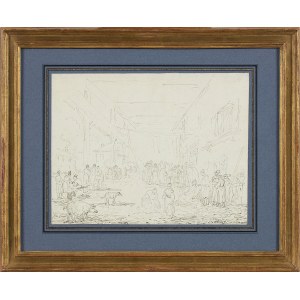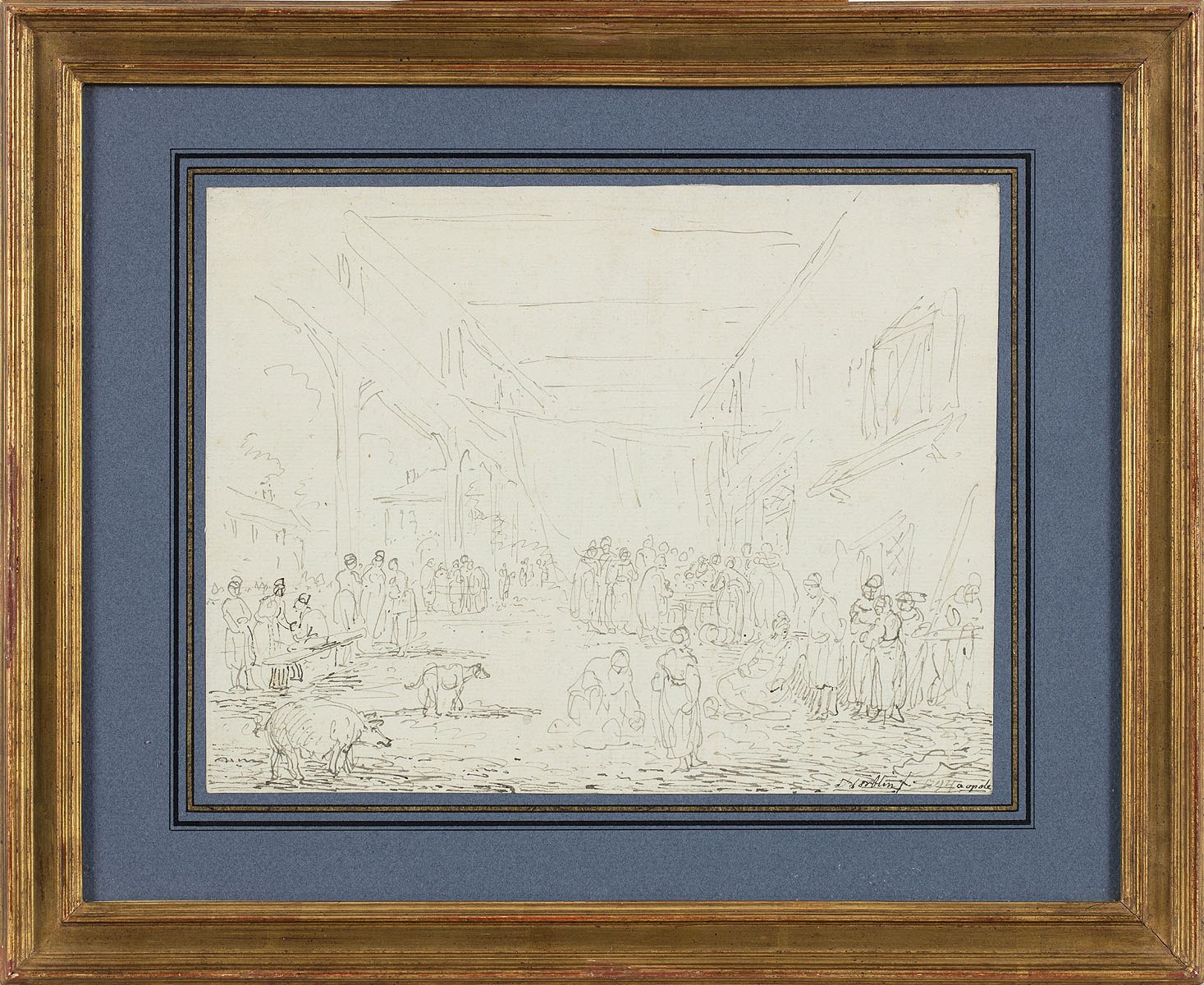
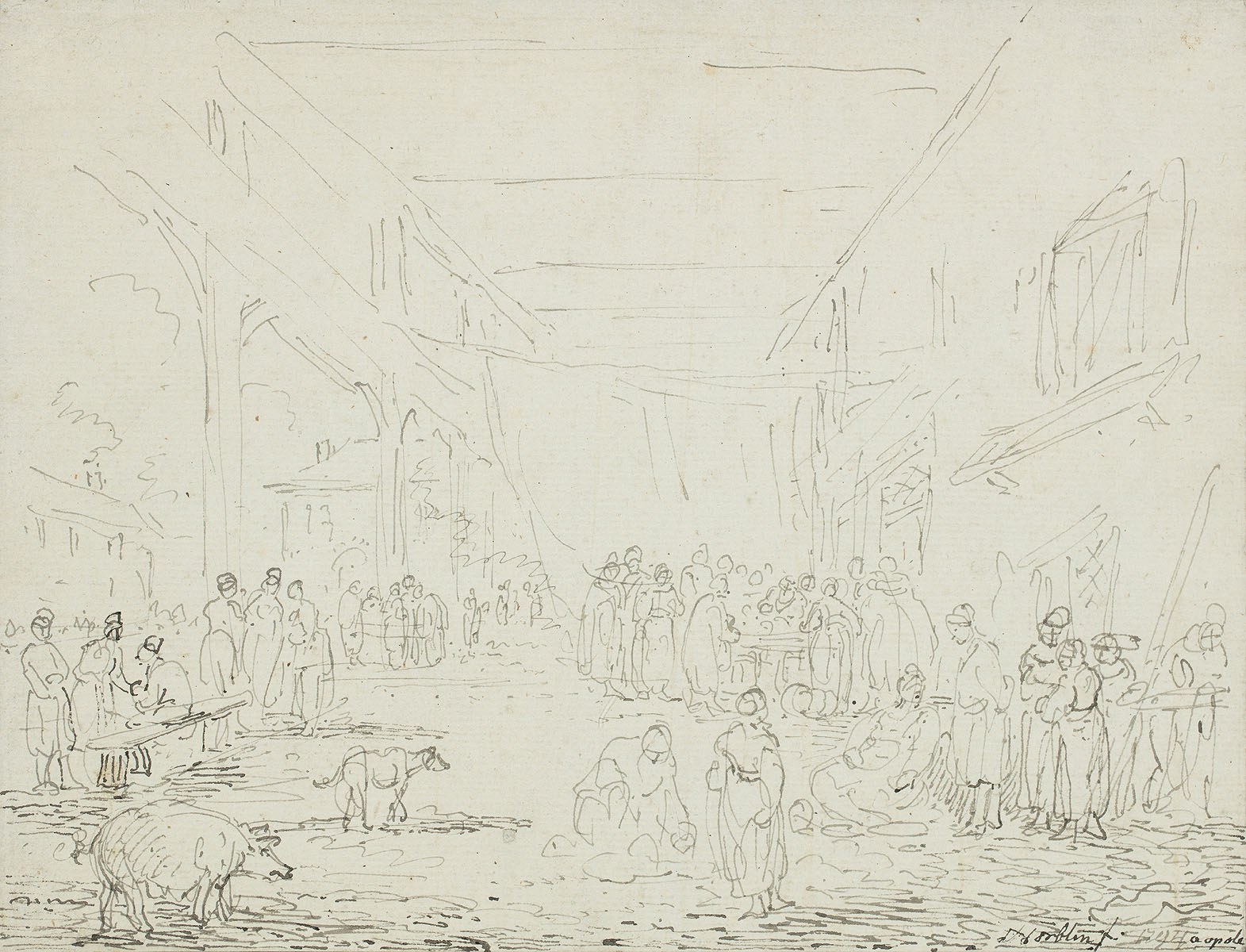
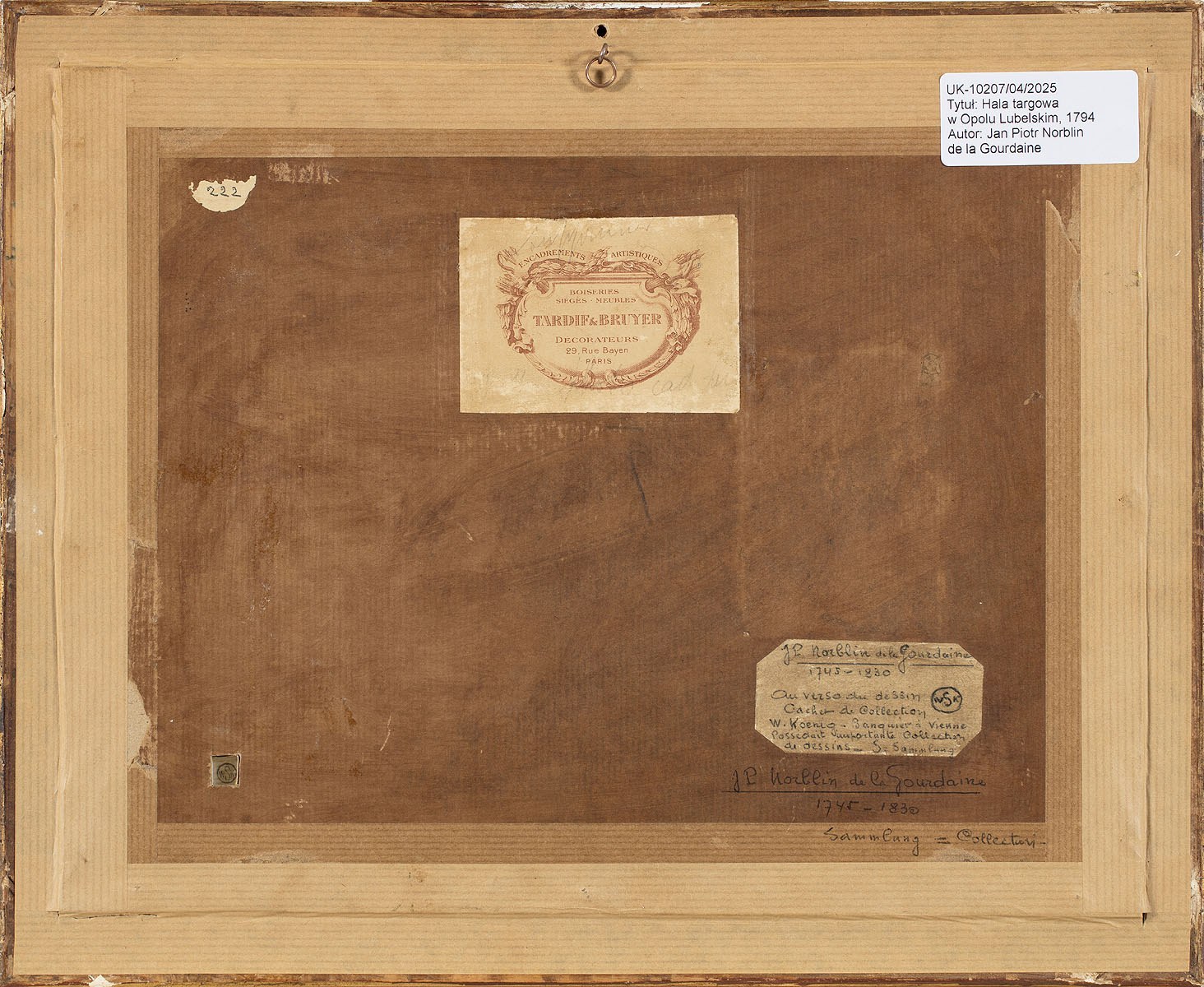
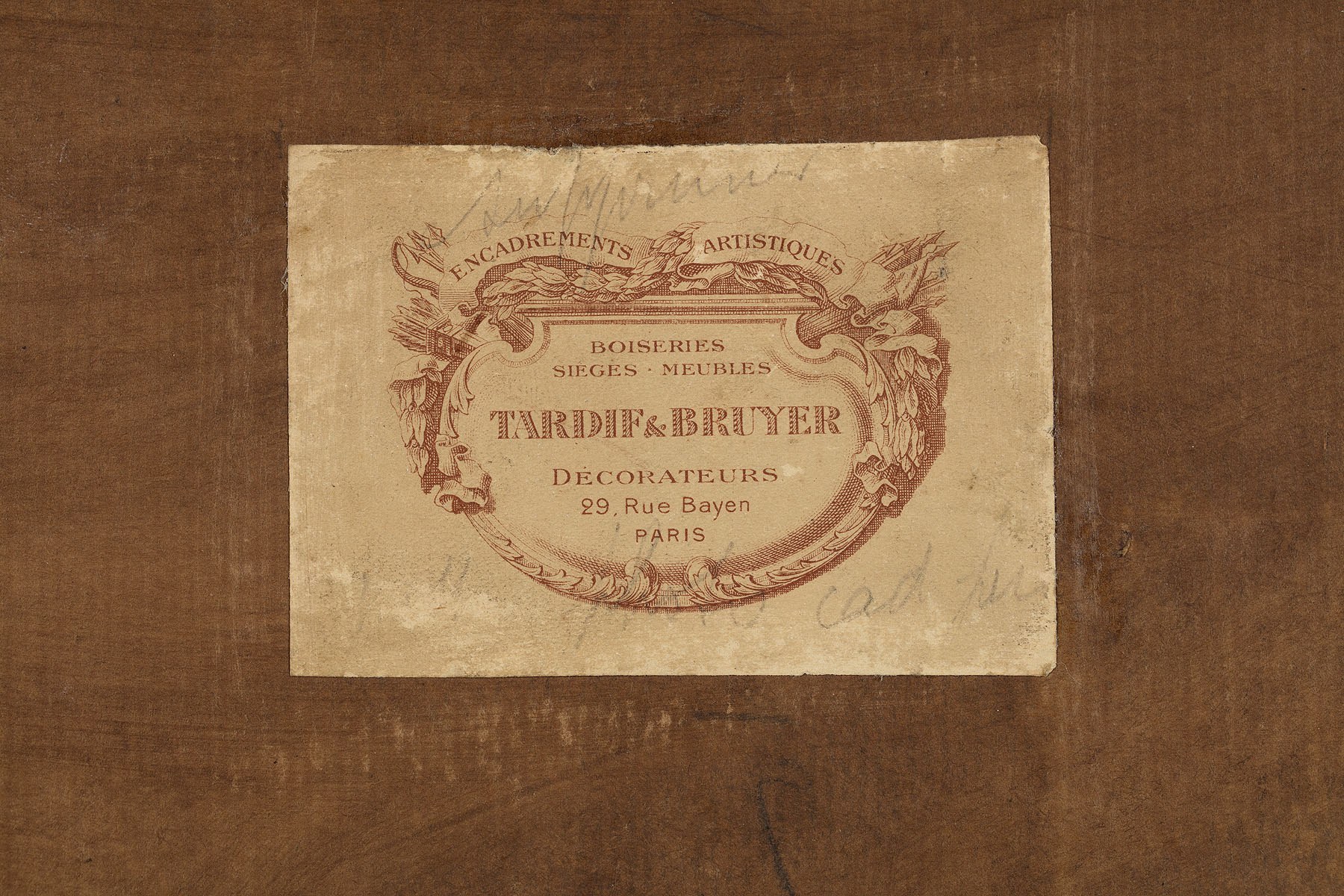
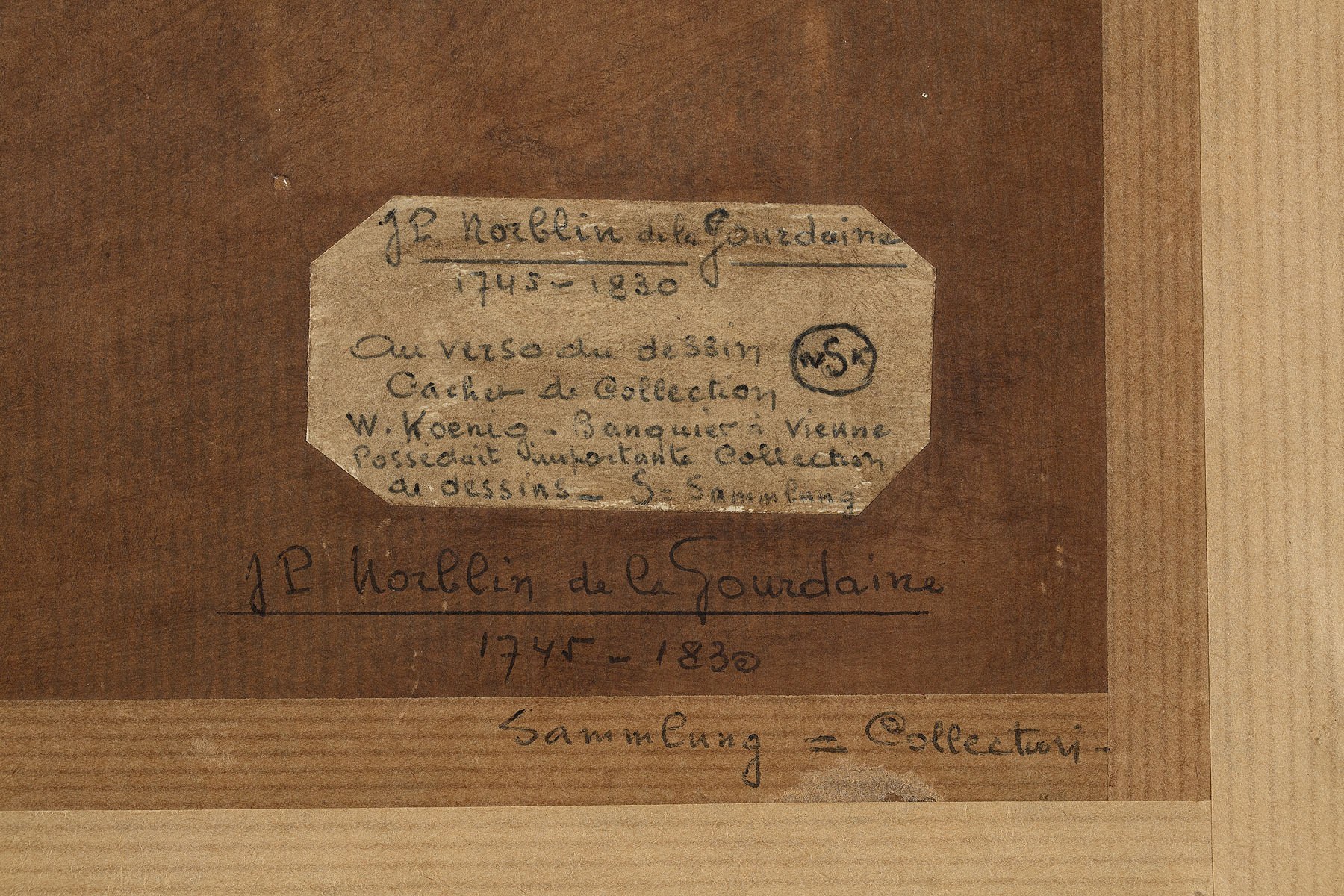
Jan Piotr Norblin de la Gourdaine (1745-1830)/ Market Hall in Opole Lubelskie/Technique: ink, paper/Dimensions: 19 x 24.7 cm/ Signed p.d.: Norblin f 1794 a opole, on the reverse the ownership stamp of W. Koenig: WSK, sticker with handwritten description of work and affiliation, sticker with number 222 and framing sticker/ Provenance: Warsaw, private collection deposit at the Royal Castle in Warsaw (2024-2025) France, private collection Vienna, collection of W. Koenig
Jan Piotr Norblin (Jean-Pierre Norblin de La Gourdaine) (15 July 1745, Misy-Faut-Yonne in Champagne - 23 February 1830, Paris) - French-Polish painter, printmaker and draughtsman of the Rococo period, one of the most important observers of Polish life and customs at the end of the 18th century.
He came from a bourgeois family; in his early youth he stayed in Paris, where already ca. 1760 he made his first drawings. He was shaped by the art of Antoine Watteau, adopting the Rococo model of composition and coloring, and later studied under Francesco Casanova, under whose influence he developed the ability to build complex scenes with multiple figures (including battle scenes). In 1769 he was noted at the Académie Royale de Peinture et de Sculpture, and later at the Ecole Royale, where he studied until 1771.
Between 1771 and 1774, he made artistic trips, including to London, where he came into contact with the art of Thomas Gainsborough and William Hogarth. During this time he met Prince Adam Casimir and Izabella Czartoryska, with whom he came to Poland in 1774. He became a court painter and drawing teacher to the Czartoryskis' children; in 1776 he married Maria Tokarska. He stayed mainly in Warsaw (the Blue Palace, Powązki), as well as in magnate centers, including Arkadia near Nieborów and Puławy.
Norblin's oeuvre in Poland ranges from Rococo scenes of park parties and the social life of the magnates (strongly alluding to Watteau and Fragonard) to an unusually rich set of drawings documenting the everyday life of the city, character types, assemblage scenes and political events of the era. Of particular note are his depictions related to the May 3 Constitution and the Kosciuszko Insurrection (including the famous "Hanging of Traitors in the Old Town Square on May 9, 1794"), thanks to which he is sometimes described as a "sentimental reporter" of his time.
He finally left Poland in 1804; he settled initially in Provins, and from 1807 lived in Paris. In France he no longer gained a position comparable to the one he had in the Republic, but for the rest of his life he returned to Polish subjects. The paintings created at that time included the Sejmik series (1808) and the extensive "Collection of Polish Clothes" series (1804-1817), as well as self-portraits (the most famous from 1812). Norblin died in 1830, leaving behind a strong influence on the Polish artistic community - his students included Aleksander Orłowski, Michał Płoński and Jan Rustem.