


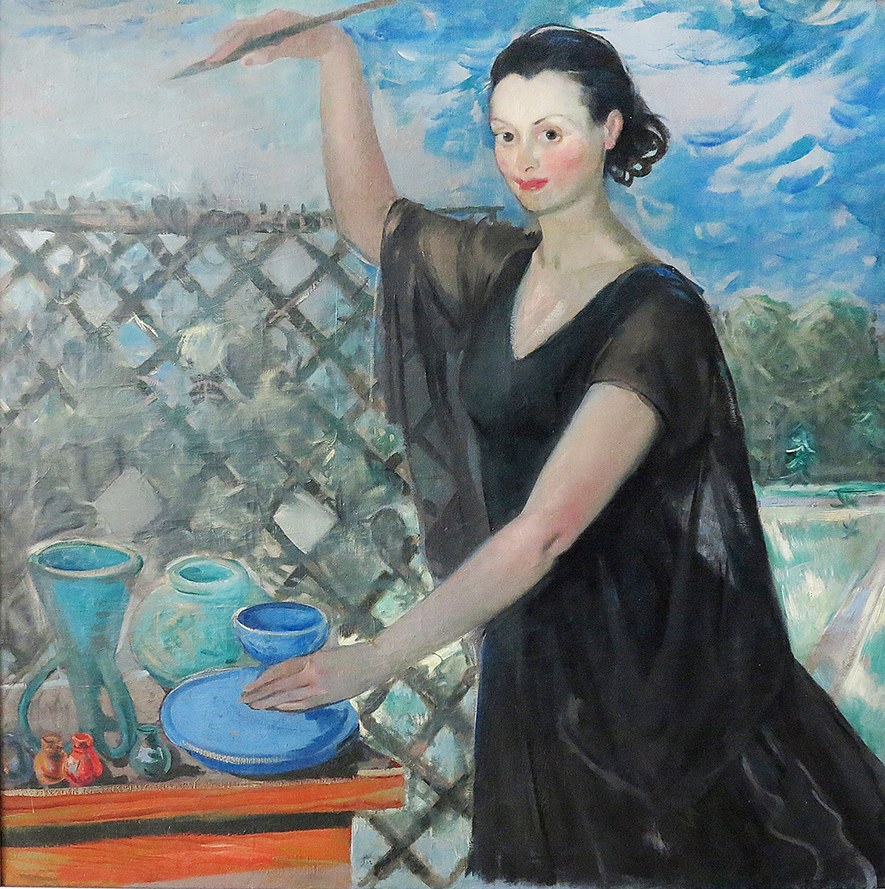
oil/canvas, 114 x 115 cm
Signed at bottom middle: TAD
The heroine of the featured painting is a young woman in a black dress, depicted in half pose, with a paintbrush in her raised hand. The portrayed is Carlotta Bologna, and the painting was probably painted by Tadeusz Pruszkowski in 1934 or 1935.
Carlotta Bologna (1909-2001) was a well-known figure in the cultural world of pre-war Warsaw and then Krakow, where she lived until the end of her life. A native Italian, she began her career in Poland as an actress, but abandoned it rather quickly in favor of artistic studies at the Warsaw School of Fine Arts. She became a student of Tadeusz Pruszkowski in 1930, and moved to Krakow in 1935, when her husband, the well-known actor and director Wiktor Biegański, was engaged at the Słowacki Theater. At the time, Pruszkowski sent a letter to Wojciech Weiss, a professor at Krakow's Academy of Fine Arts, recommending his student.
After World War II, Carlotta Bologna devoted herself fully to painting. She had many solo exhibitions both at home and abroad. On the occasion of one of her presentations, the Gazeta Lodza newspaper published an article about the artist in 1993, which read: "As a woman of uncommon beauty, she was often portrayed by painters. Three times she was painted by Tadeusz Pruszkowski. Two portraits painted by Roman Kramsztyk were lost (one was burned in the Warsaw Uprising). She was also a model for the portraitist of Krakow actresses Alfons Karpinski."
Another painting by Pruszkowski depicting Bologna is known - it is "Portrait with Flowers," created before 1934 (National Museum in Warsaw).
The painting offered at the auction was reproduced in the version before conservation (with a different background) in the "Antiquarian Gazette" of 1999 (no. 3) in the article by Zofia Weiss - Nowina Konopczyna "Carlotta Bologna. Una parmigiana di Cracovia," and later, in the artist's monograph published in 2006, "Carlotta Bologna. Flashes from Life." For both publications, the reproduction was signed: "Painter of Ceramics." In turn, Bologna herself recalled: "Prusz painted three portraits of me - one very large one was titled 'Painter of Ceramics.' It was a commission for a salon on Batory. In general, he was commissioned to supervise the artistic arrangement of the entire ship - he was away for two weeks at the time. "He painted "Painter of Ceramics" for Saturday and Sunday, so I posed twice, two days from 10 a.m. to 5 p.m. It's hard to believe, I was only in one week, and then he finished the painting already without the "model".
It is known that Tadeusz Pruszkowski, in his very active social activity, was also a member of the art sub-committee of the Transatlantic Shipbuilding Supervisory Commission (1934) and had a direct influence on the artistic design of Polish passenger ships. It is therefore highly likely that, according to the information provided in the article and the painter's biography, this unique portrait decorated one of the interiors of the Batory. Unfortunately, this could not be confirmed in the existing documentation. Unlike the first ship M/S Pilsudski, the transatlantic liner Batory did not live to see the publication of a catalog of the artworks displayed in its interiors.
In Pruszkowski's work, portraiture occupies a prominent place. The artist was often inspired by the art of the old masters, he used a half-figure shot, and portrayed portrayed women surrounded by objects (a jug, beads, a musical instrument), emphasizing their personality or indicating the symbolic or metaphorical meaning of the image.










हाल ही में देखी गई
लॉट लिस्ट देखने के लिए कृपया लॉग इन करें
पसंदीदा
लॉट लिस्ट देखने के लिए कृपया लॉग इन करें