


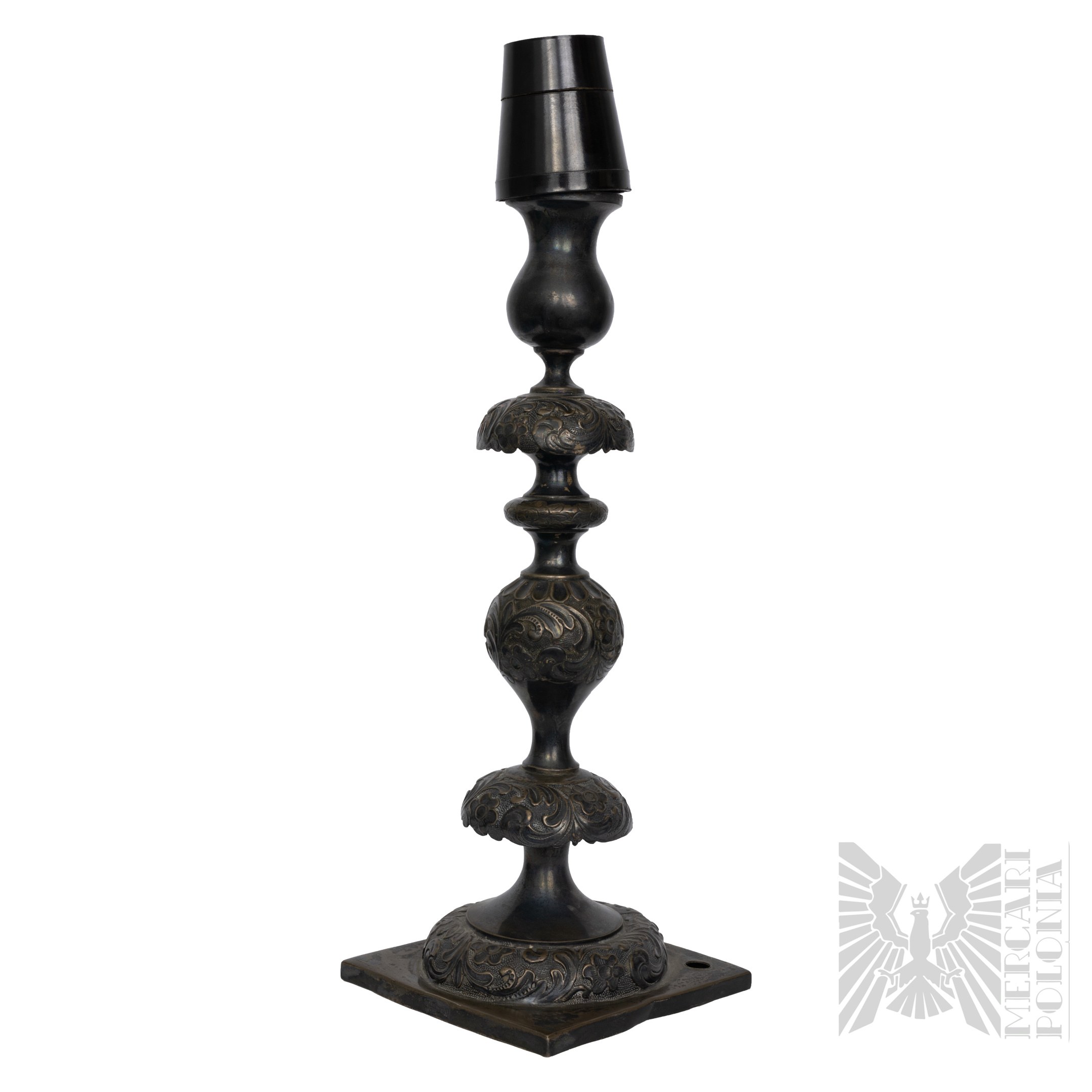
Warsaw, 1860, Kingdom of Poland. Goldsmith’s workshop unknown. Silver with a fineness of 84 zlotyk, corresponding to 875/1000. Hammered and embossed silver, cast and chiseled elements, relief decoration; partially hollow construction. In the 20th century, the candelabrum was retrofitted to function as an electric lamp.
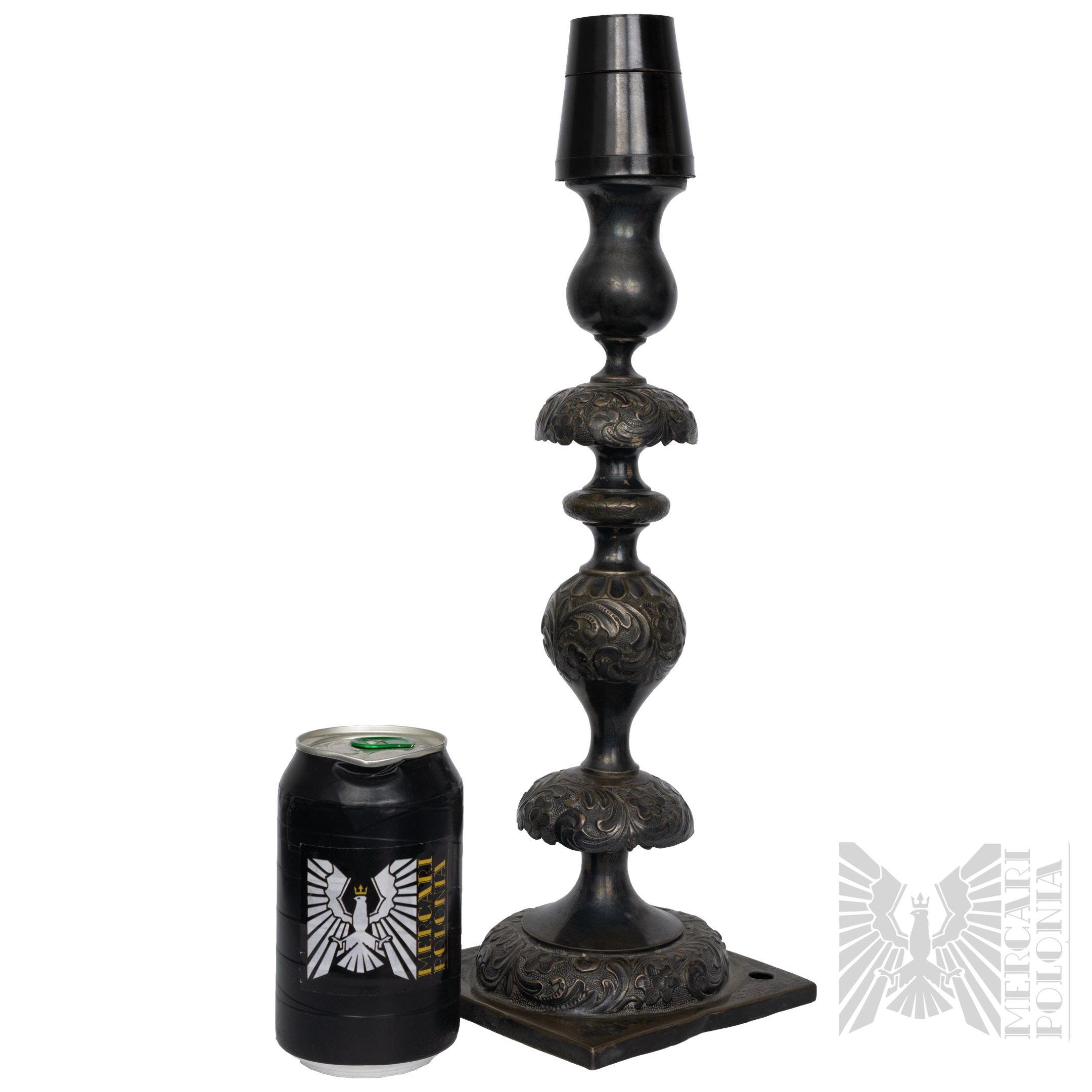
Height in its current condition: 38 cm; base: 12 × 12 cm.
Weight: 466 g.
A single-candle candelabrum with a tall, slender, and highly articulated silhouette, supported by a square, flat plinth. Set upon it is a circular, convex base decorated with a rich relief floral ornamentation, composed of fleshy leaves, volutes, and rocaille motifs. A profiled, baluster-like shaft rises from the central part of the base, formed from a series of alternately tapering and bulbous sections.
The lower node takes the form of an elongated, pear-shaped bulb, the upper part of which is adorned with a relief featuring leaf, scroll, and floral motifs. Above this is a wide, umbrella-shaped collar with a wavy edge, also covered with floral decoration, followed by a narrowing section and another similar but smaller segment. The whole is crowned by a tall, smooth baluster section with a bulbous profile. The preserved composition is characteristic of Warsaw silverware from the mid-19th century, particularly the Neo-Baroque and Neo-Rococo styles.
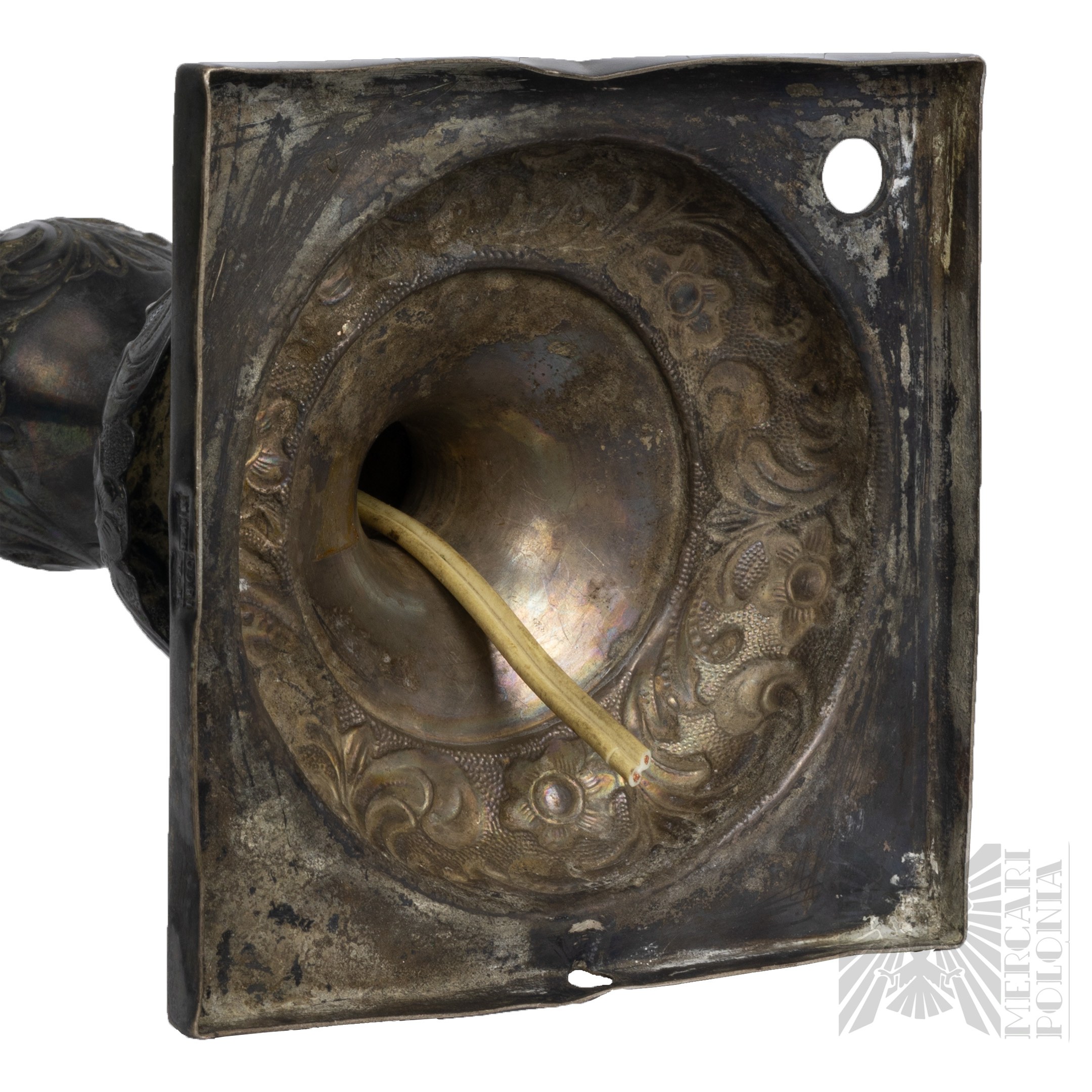
The interior of the flared base is visible from below. Around the central, funnel-shaped recess, rich embossed floral and plant decoration has been preserved. Traces of later alterations are also visible, as well as electrical wiring running through the interior of the shaft. A black electrical socket has been mounted in the upper part of the candlestick. This modification dates from the 20th century and is not part of the object’s original design; originally, the piece served as a single-candle candlestick.
The hallmark allows the object to be dated precisely to 1860. The mark contains the assayer’s initials “W.K.,” the date, and the fineness mark 84, and belongs to the system used by the Warsaw Assay Office, established in 1852. During this period, the office hallmarked silver using a system modeled after the Russian one, with its own distinctive mark of the Warsaw assay office. The initials “W.K.” are identified as the mark of Walerian—also referred to in the literature as Walery Kostrzębski—a Warsaw assayer active from 1852 to 1860. Similar W.K. marks dated 1860 can be found on preserved Warsaw silver pieces that have been cataloged by museums.
However, the photographs presented do not allow for the unambiguous identification of the goldsmith’s personal or shop mark; therefore, the workshop of origin must be left undetermined. The high quality of craftsmanship and the decorative repertoire alone place the object within the circle of fine Warsaw goldsmithing from around the mid-19th century; however, attributing it to Malcz, Nast, Pogorzelski, Radke, Luther, or any other specific master without the appropriate hallmark would be unjustified.
Condition: as shown in the photos.








हाल ही में देखी गई
लॉट लिस्ट देखने के लिए कृपया लॉग इन करें
पसंदीदा
लॉट लिस्ट देखने के लिए कृपया लॉग इन करें