


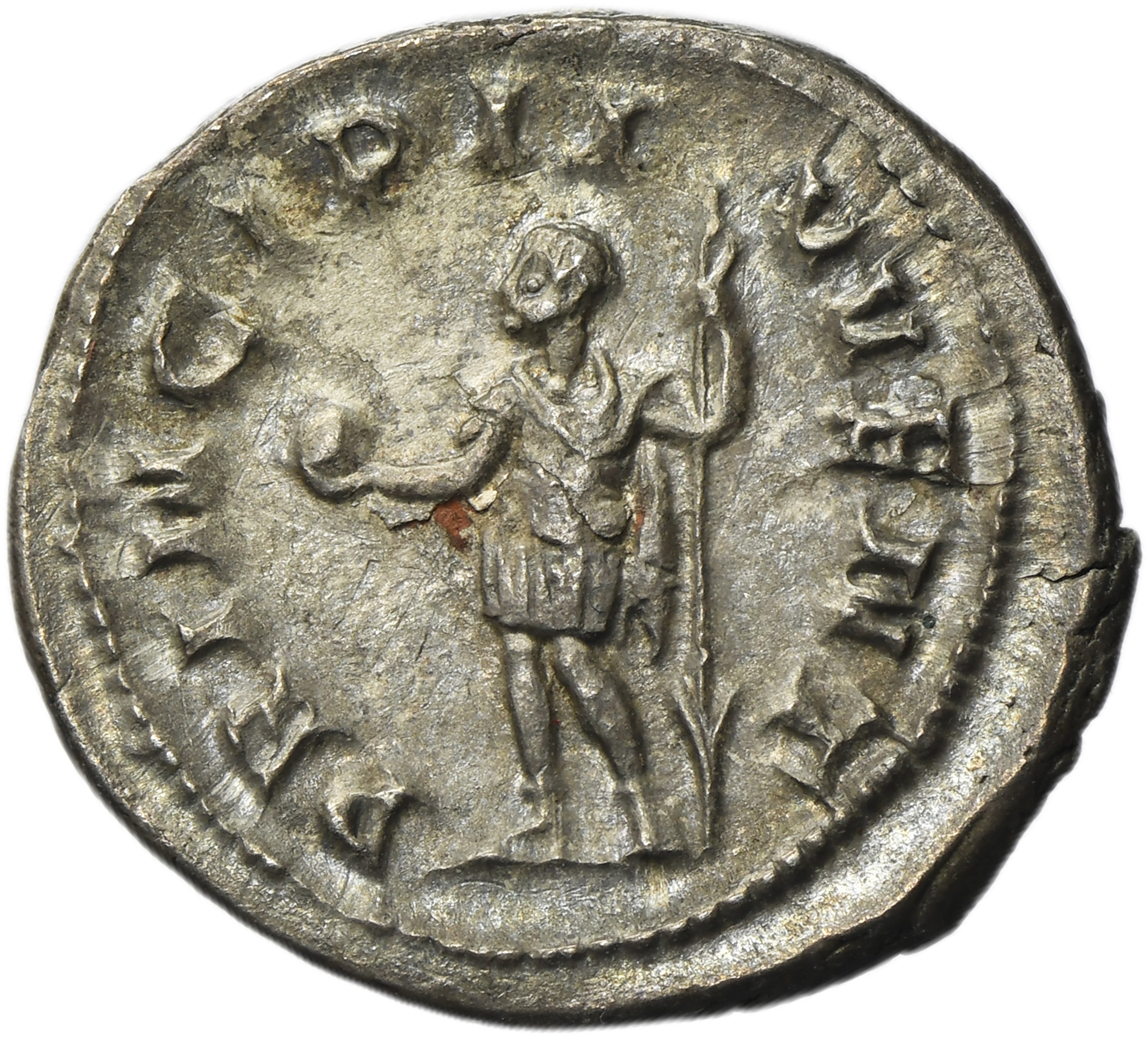


Antoninian of Philip II (AD 244–249 as Caesar), struck at the Rome mint between AD 244–246, belongs to the earliest phase of his public career, immediately following his elevation to the rank of Caesar by Philip I the Arab. Coinage from this period forms a key component of the dynastic program, through which the young heir was systematically introduced into official imperial imagery.
The obverse features a radiate, draped and cuirassed bust of Philip II facing right, with the legend M IVL PHILIPPVS CAES, clearly identifying him as Caesar. The radiate crown denotes the antoninianus denomination, which by the mid-3rd century had become the principal silver coin, despite the ongoing reduction in intrinsic silver content.
The reverse shows the young ruler in military attire, standing left, holding a globe and a spear, with the legend PRINCIPI IVVENT. The title Princeps Iuventutis was traditionally conferred upon imperial heirs and constituted a central element of dynastic representation, emphasizing their future role as leaders of both state and army. The globe symbolizes dominion, while the spear refers to military authority and the defense of the empire.
This type belongs to a well-documented series of early issues of Philip II, in which titulature and iconography combine to articulate his position within the imperial succession.
Roman Imperial
Philip II (247-249), Antoninianus 244-246, Rome mint
Obverse: radiate, draped and cuirassed bust right
M IVL PHILIPPVS CAES
Reverse: emperor in military attire, standing to leftt, holding globe in right hand and holding transverse spear in left
PRINCIPI IVVENT
Diameter 23 mm, weight 4.53 g











