


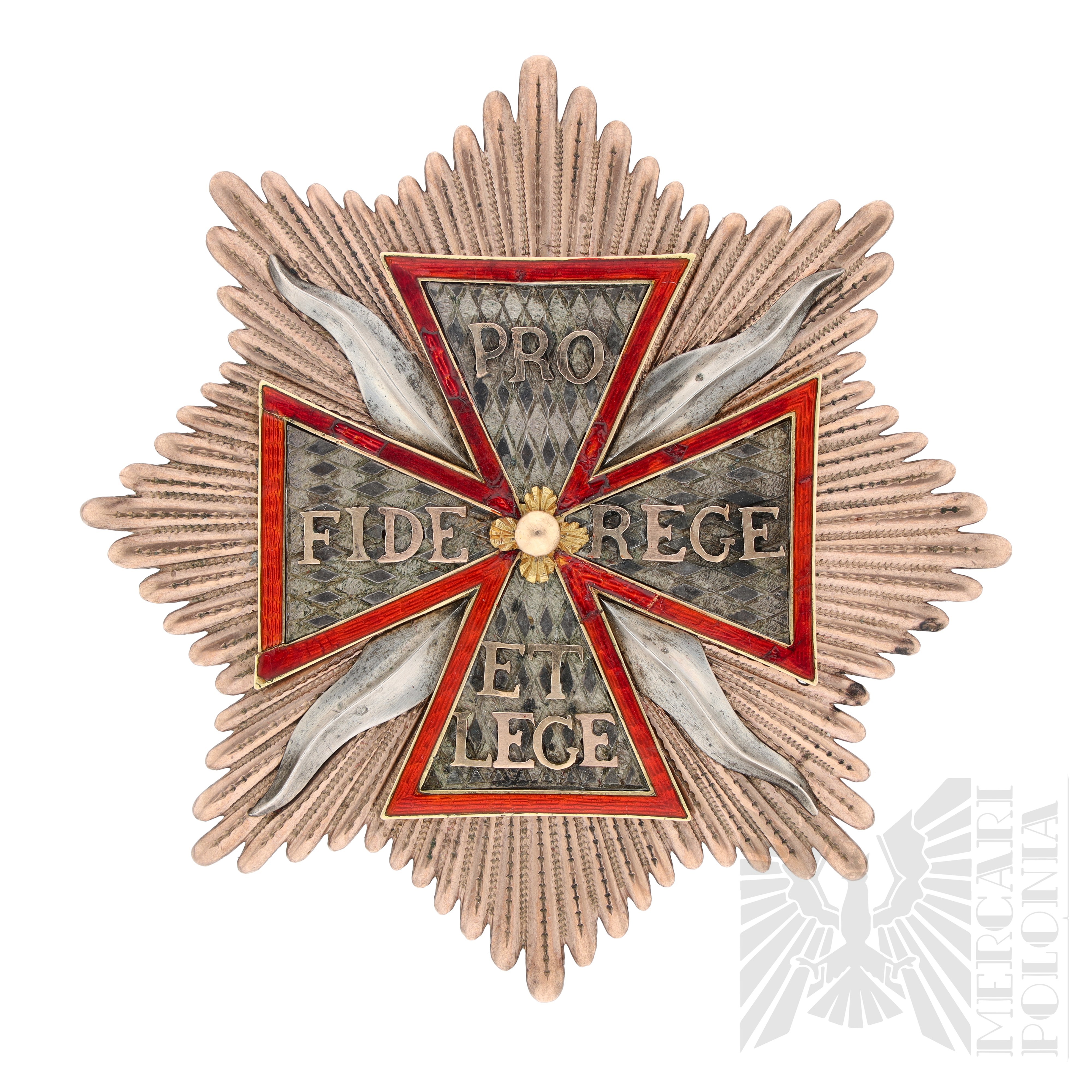
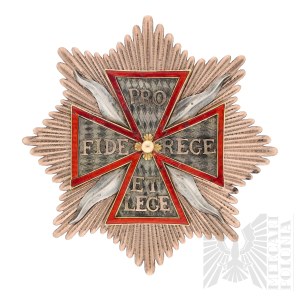
The piece presented here is a very rare example of a 19th-century star of the Order of the White Eagle. It dates from the period of the Kingdom of Poland—an era highly prized by falerists. The star’s value is enhanced by the limited number of awards granted during that era and the elegance of its craftsmanship. Items of this caliber appear on the market only sporadically, and their historical, artistic, and investment value is very high.
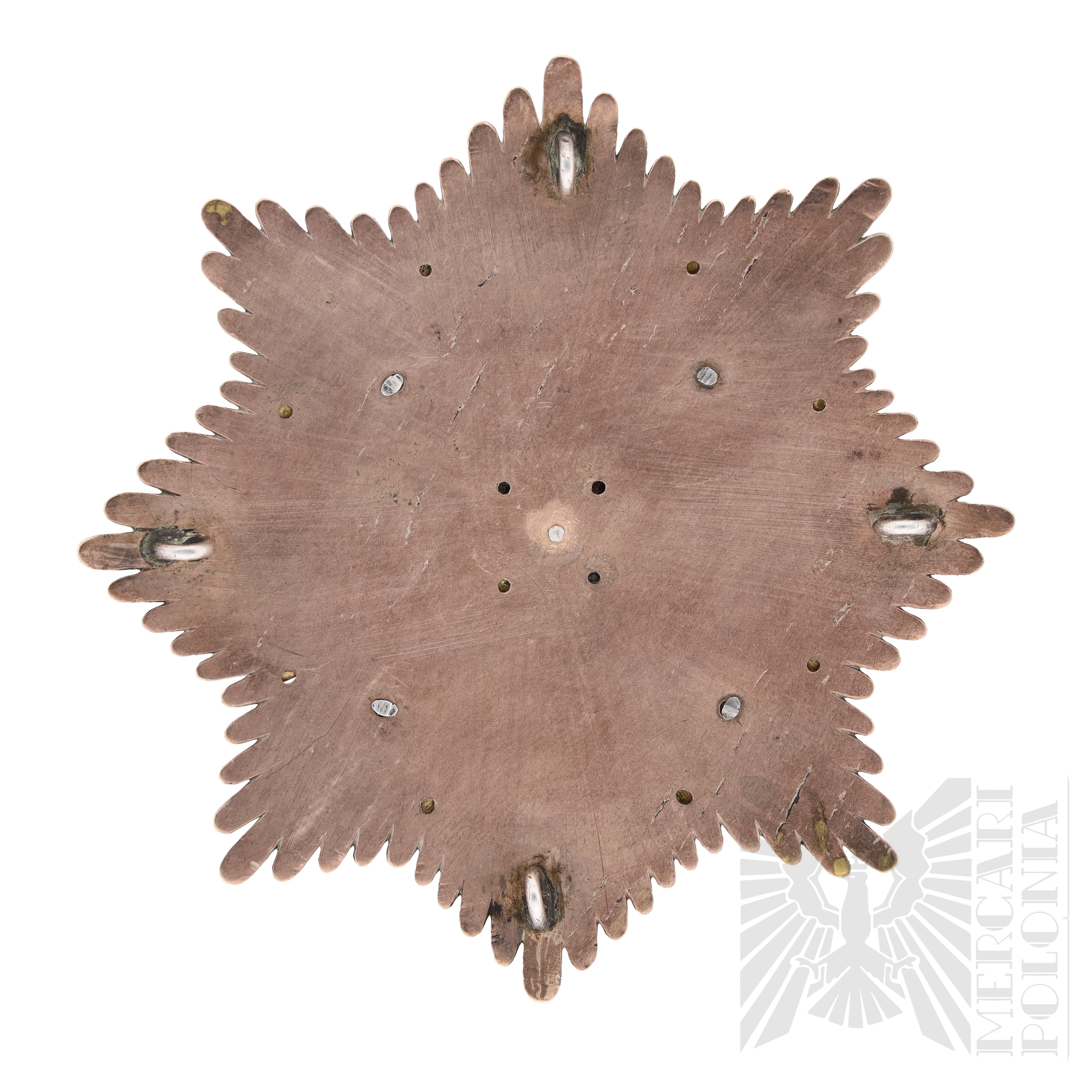
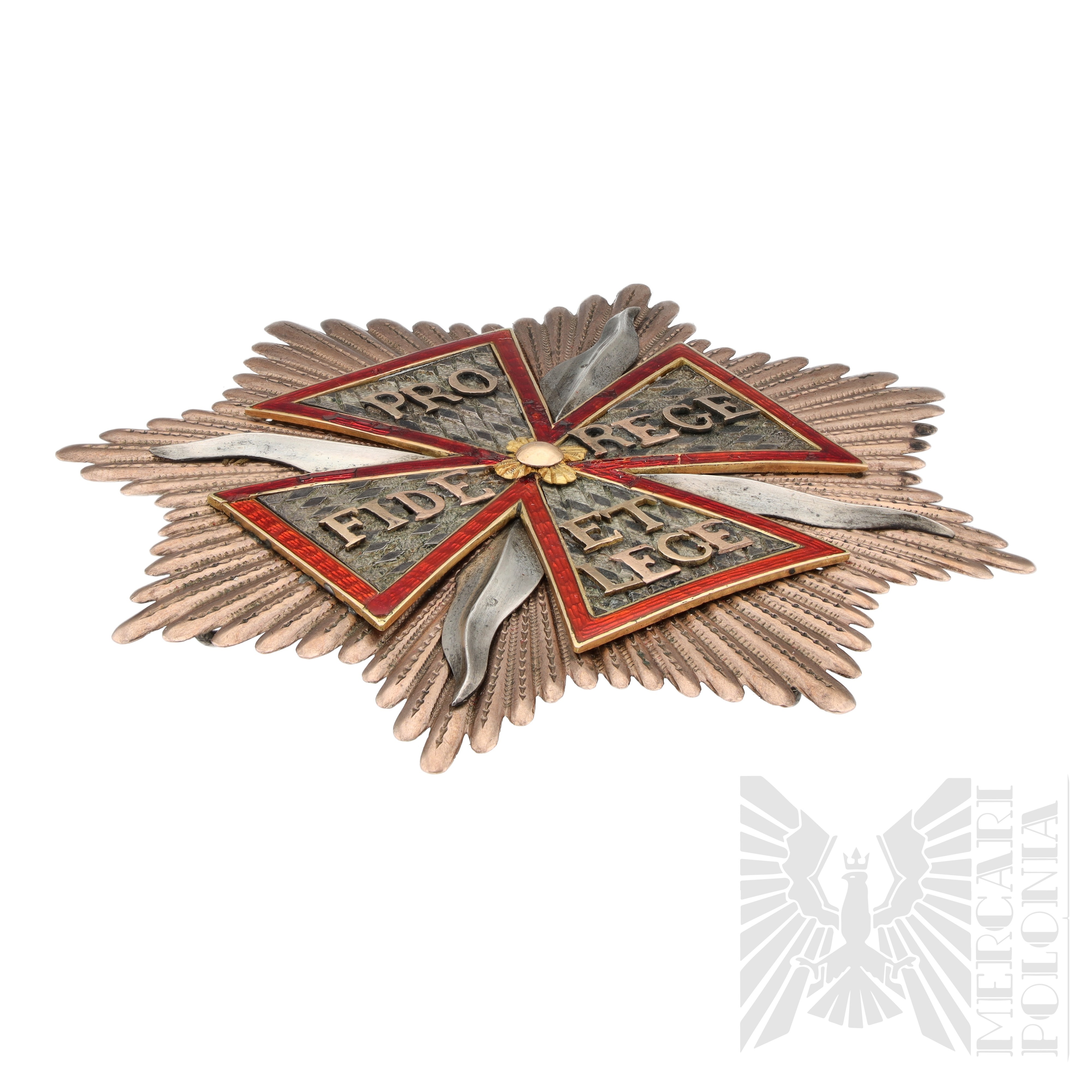
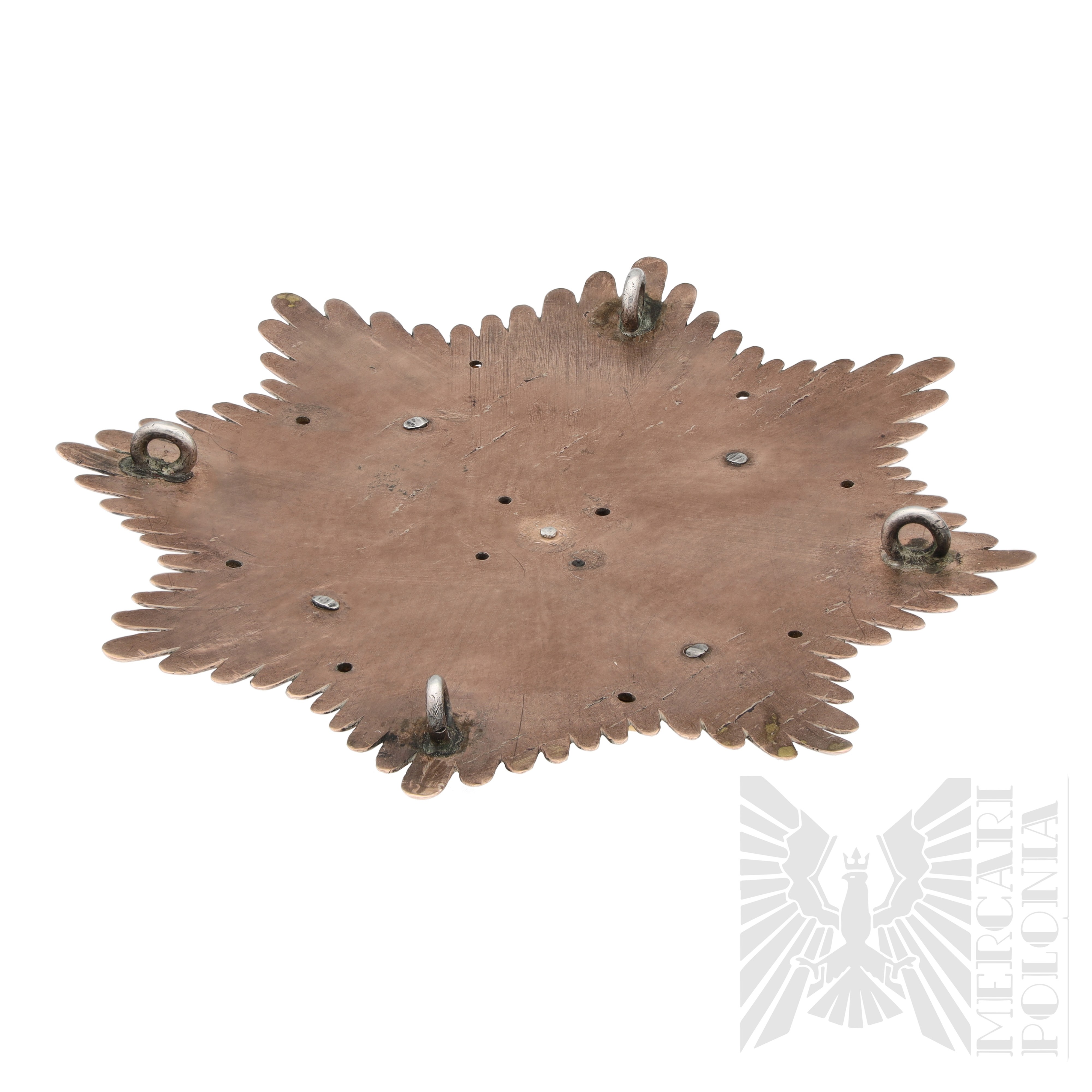
An eight-pointed star, made of silver and gilded, featuring a Knight’s Cross of the Order at its center and red enamel along the edges of the arms. Inside the arms of the cross, against a diamond-patterned background, the order’s motto “Pro Fide, Rege et Lege” (For Faith, King, and Law) is inscribed in gold letters. Between the arms of the cross are four wavy silver rays. In the center, the pin securing the order’s components is surrounded by golden rays, stylized as a small star. The design of the fastening pin is similar to that of the OOB star named after Henryk Dąbrowski; the rays on the obverse are reminiscent of a French-made star.
The star’s form is characteristic of the period of the Kingdom of Poland, as described in the relevant literature: “After 1815 […] the method of crafting order stars changed; most were made of metal—specifically, silver with gold or gilded elements—and were enameled and engraved. In some pieces, the diameter of the stars is approximately 75 mm; there are also slightly larger ones, about 95 mm. Jewelry-making techniques allow for a more distinct rendering of individual elements. Red enamel was also used, covering the edges of the Knight’s Cross, as well as white enamel, which fills the surface of the cross’s arms. The shape of the clusters of rays varies. Similarly, the rays between the arms of the cross are sometimes engraved, sometimes smooth, and sometimes wavy.” It is not difficult to see that the metal order stars from the time of the Kingdom of Poland were very similar to the embroidered order stars from the time of Stanisław August (cf. the portrait of Barnaba Jabłonowski, Voivode of Poznań, by Józef Grassi, 1791)
Dimensions: diameter at the widest point 8 cm, weight 36.47 g.
Condition as shown in the photos.
The Order of the White Eagle is the oldest and highest Polish decoration. It was established in 1705 by King Augustus II Wettin. In the 18th and 19th centuries, the design of the Order’s Cross evolved—from the original oval medal bearing the image of a white eagle to a white eagle on the breast of a black Russian eagle; the Order’s stars differed in their details. Generally, they consisted of an eight-pointed star with a knight’s cross superimposed on it, bearing the motto “Pro Fide Rege et Lege” and four rays on either side. The greatest variation is seen in the rays, which took on highly fanciful shapes, and the central pin (which was sometimes omitted).
In the early years of its existence, the order was awarded relatively rarely; later, more frequently; and during the reign of Stanisław August—almost en masse. It ceased to function after 1795; it was reinstated during the time of the Duchy of Warsaw. However, during the period of Napoleonic Poland, only 11 people were awarded the Order of the White Eagle. After Napoleon’s fall, the order remained in the newly established Kingdom of Poland until the November Uprising. During the Kingdom of Poland, more people were awarded the order than during the Duchy—about 70 in total. The order was not awarded during the November Uprising. After the uprising’s defeat, Nicholas I incorporated the order into the Russian system of decorations. At that time, both the nature and appearance of the order changed radically.
The Star of the Order of the White Eagle reproduced in Krzysztof Filipow’s monograph (“Order of the White Eagle,” 1995, p. 35); it differs only in the enameled circle around the central rivet and the slightly different appearance of that rivet. It is described as “an order star made of gold from the Kingdom of Poland (1815–18130).” Similar variants were often reproduced; cf. Fleck’s 1849 lithograph: “A Knight of the Order of the White Eagle in Poland in ceremonial dress and the order’s insignia,” and the collection of images of the Order of the White Eagle at the National Museum in Warsaw (“Star of the Order of the White Eagle from a portrait of Franciszek Bieliński, Grand Marshal of the Crown,” “Star of the Order of the White Eagle from the collection of Antoni Strzałecki,” “Orders—crosses and stars—Virtuti Militari, the White Eagle, St. Stanislaus, and Polonia Restituta from the collections of the National Museum in Warsaw”), metal order stars from the era of the Kingdom of Poland—illustrations by Adam Jońca for the book *Polish Orders and Decorations*.
Bibliography: Krzysztof Filipow, Order of the White Eagle, Białystok 1995; Wanda Bigoszewska, Polish Orders and Decorations, Warsaw 1989.








हाल ही में देखी गई
लॉट लिस्ट देखने के लिए कृपया लॉग इन करें
पसंदीदा
लॉट लिस्ट देखने के लिए कृपया लॉग इन करें