


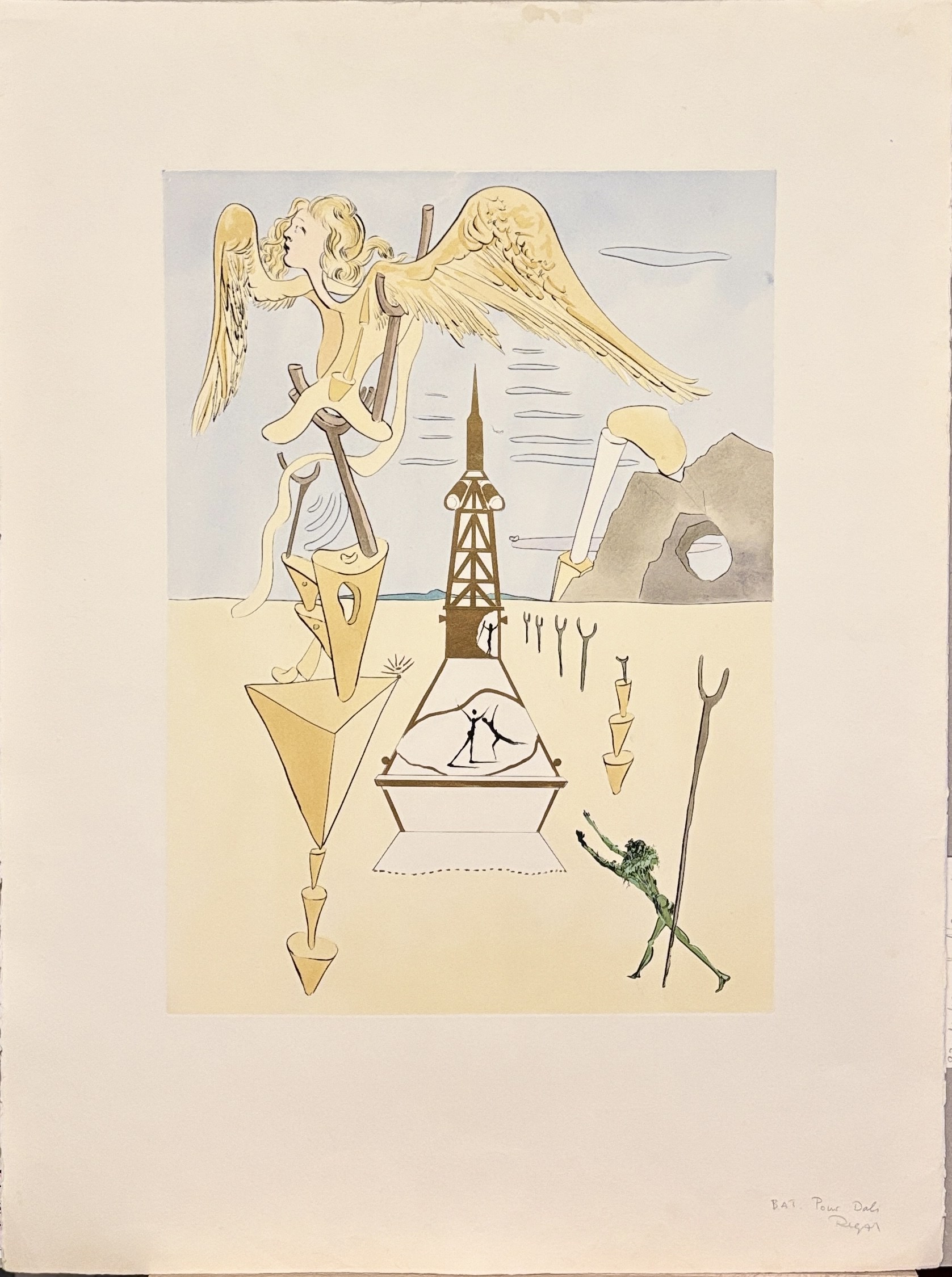
Drypoint, hand-colored with watercolor using the "pochoir" technique on Arches handmade cotton paper with a watermark;
Plate print dimensions: 50.5 x 36.5 cm; sheet size: 57 x 76 cm;
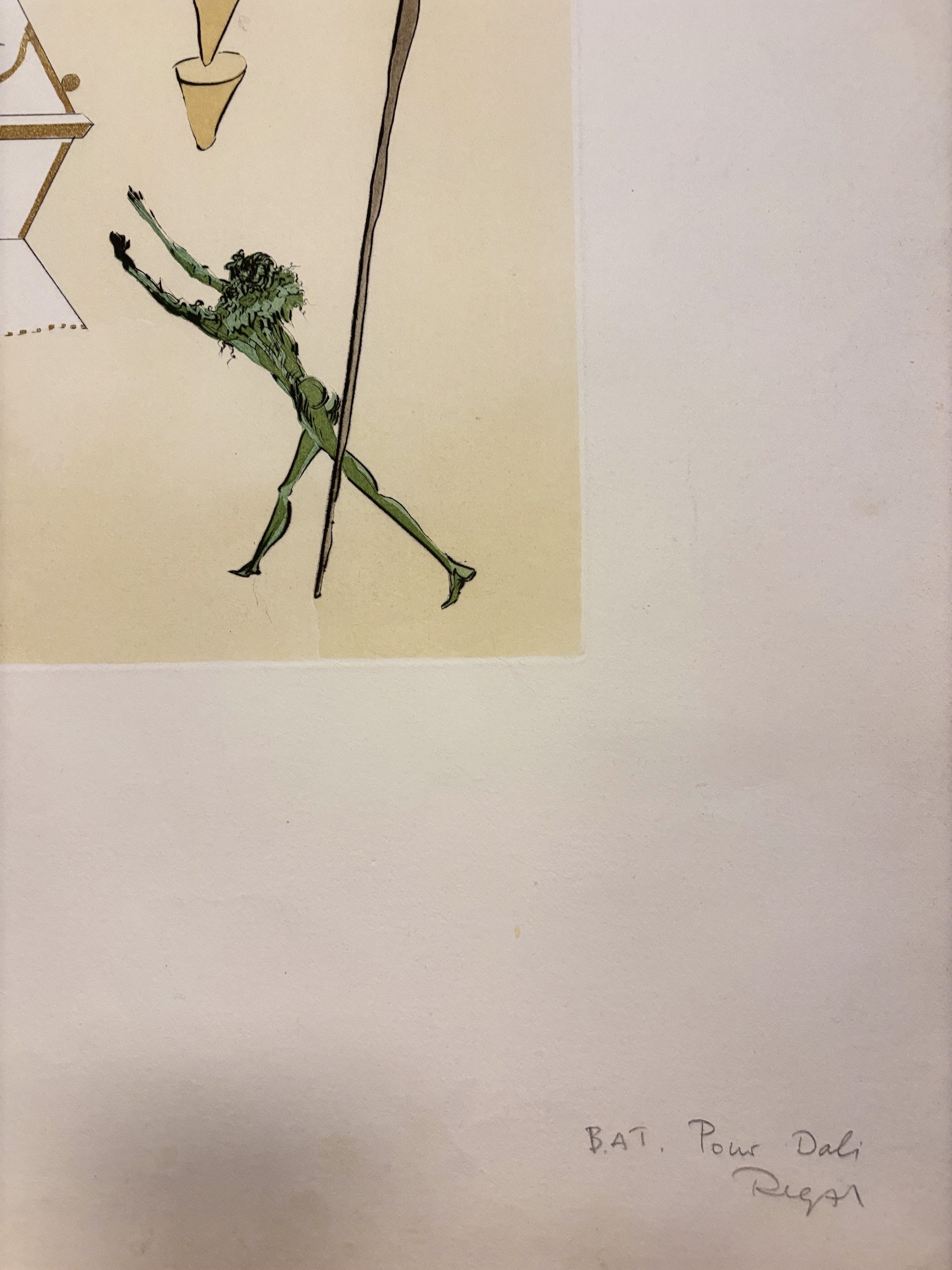
In the lower right corner, written in pencil by Atelier Rigal: “BAT pour Dali” and Master Rigal’s signature.
Final print intended personally for Salvador Dalí.
On a B.A.T.-type print from Atelier Rigal bearing the personal signature of Master Rigal, the master printmaker (imprimeur) Master Rigal, who carried out the printing and coloring process and confirmed that this specific piece serves as the perfect model for the entire subsequent print run.
The abbreviation B.A.T. (or BAT) on the print comes from French and stands for “Bon à tirer” (literally: “good to print” or “ready to print”).
Here is the exact meaning of this notation in the field of printmaking:
Master Piece: This is a unique, historic piece that serves as the ideal standard for color, tone, and technique in the production of prints.
It sets the standard for the entire print run: the printmaker producing the entire subsequent series (a numbered edition) had to follow this specific print—each subsequent print had to perfectly match the BAT copy.
A Bon à tirer print usually exists as a single piece for a given plate. It is not part of the numbered commercial edition (it is outside the numbering sequence, e.g., alongside A.P. / E.A. – Épreuve d'artiste pieces). For this reason, pieces marked “BAT” are particularly sought after and highly valued by collectors in the art market.
Publisher: Éditions Graphiques Internationales, Paris 1975;
Produced by: Ateliers Rigal
References:
-Salvador Dalí, *Catalogue Raisonné of Lithographs and Woodcuts*, by Ralf Michler and W. Lopsinger, #812
-Albert Field #75-8; pp. 106–107
Provenance: from the collection of Maurice Beaufumé, who was responsible for coloring the prints produced at Atelier Rigal.
Maurice Beaufumé was an outstanding French master of the artistic crafts, an engraver and colorist who became world-renowned for his mastery of the traditional hand-stencil technique known as pochoir.
The 1975 series *Hommage à Leonardo da Vinci* (also known in the literature as *Great American Inventions*) is one of Salvador Dalí’s most significant mature graphic achievements. The portfolio represents an extraordinary fusion of Dalí’s fascination with science, modern technology, and the artistry of the Italian Renaissance master—Leonardo da Vinci. In this series, Dalí juxtaposes two worlds: the precision of engineering thought and his own paranoid-critical surrealist imagination. Drawing inspiration from Leonardo’s famous sketchbooks and manuscripts (the Codex),
Dalí took on world-revolutionizing inventions (primarily from the 19th and 20th centuries) and incorporated them into a landscape rich in symbolism.
The binding shown in the visuals is for illustrative purposes only and does not constitute a commercial offer.










हाल ही में देखी गई
लॉट लिस्ट देखने के लिए कृपया लॉग इन करें
पसंदीदा
लॉट लिस्ट देखने के लिए कृपया लॉग इन करें