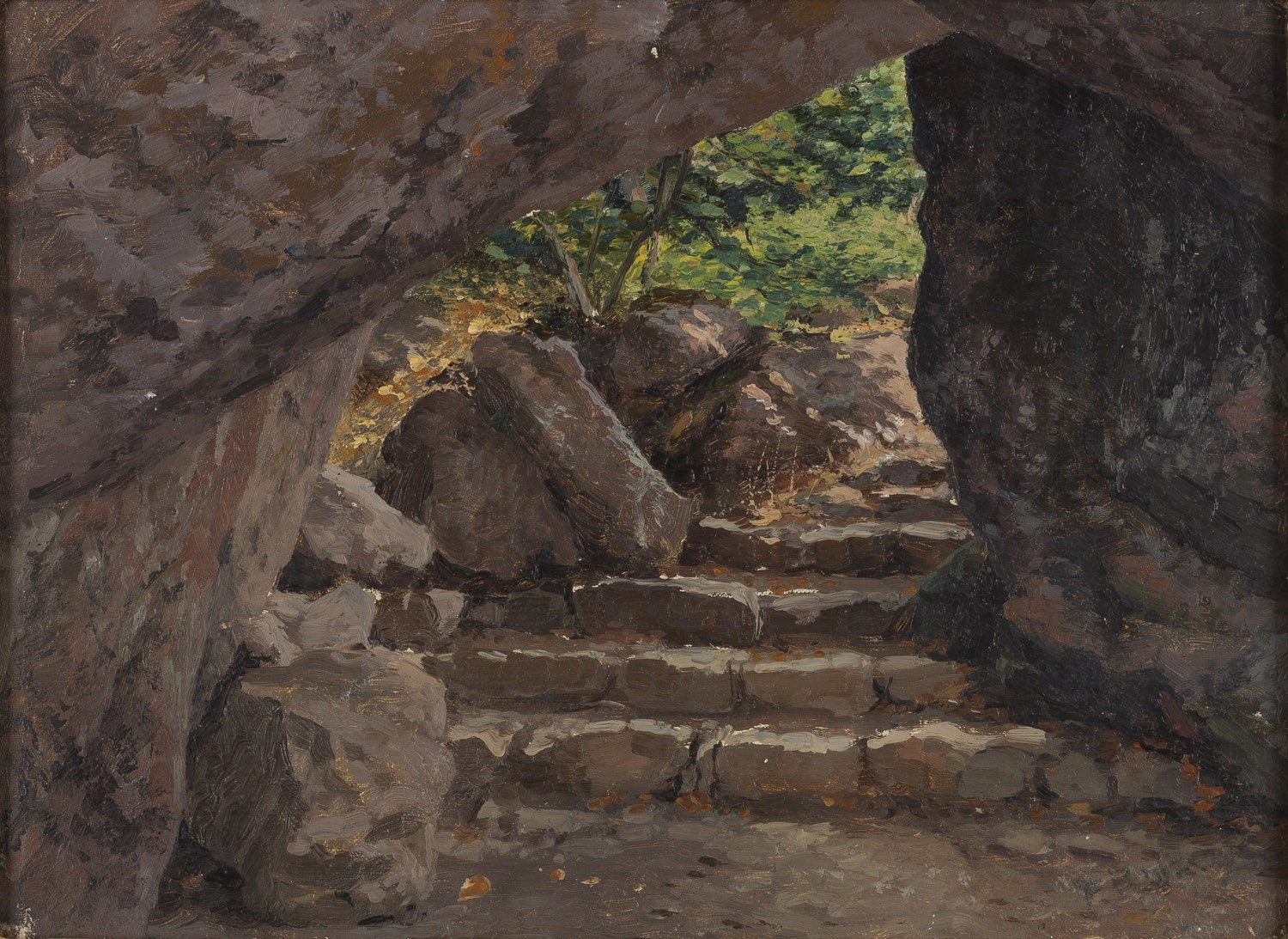
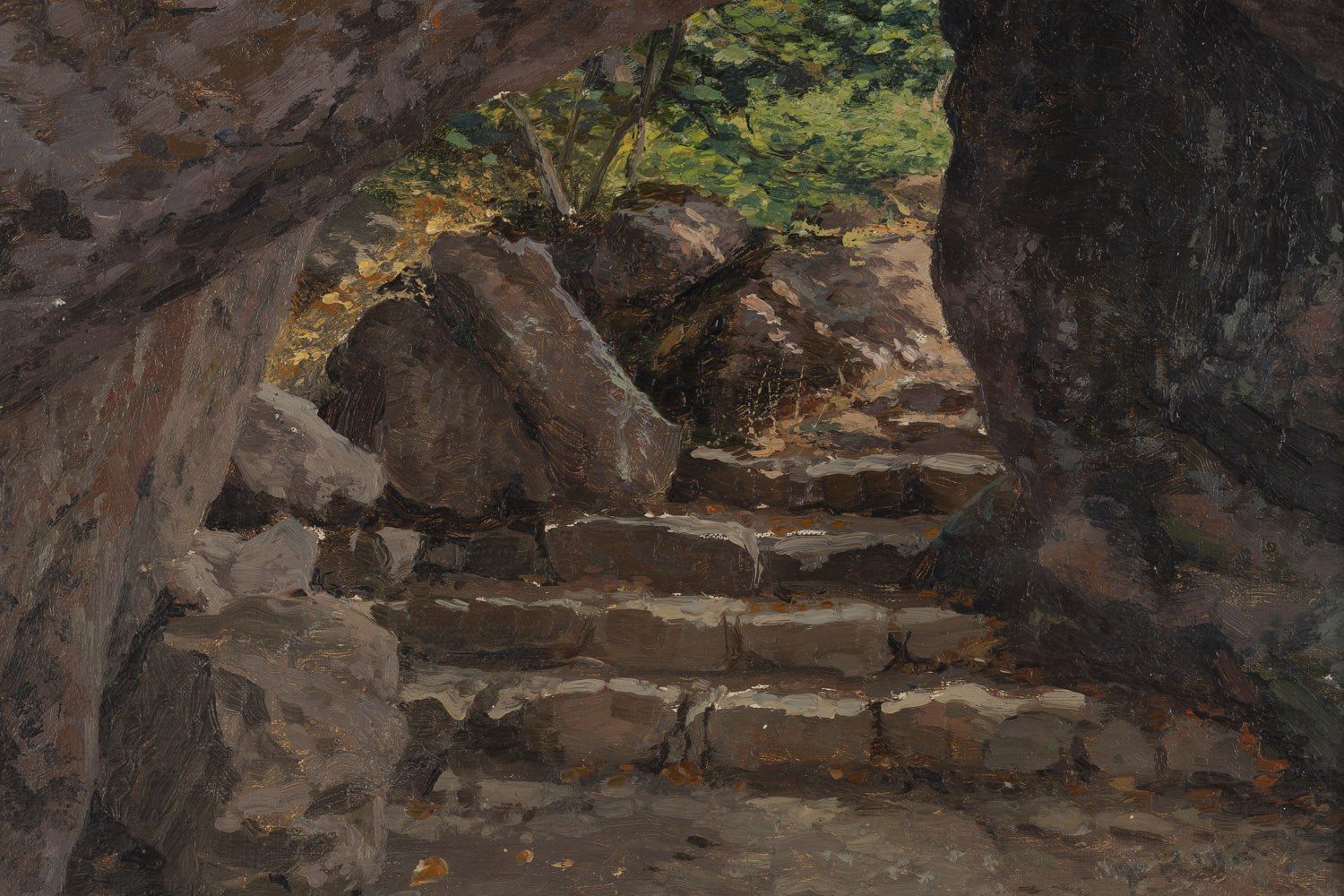
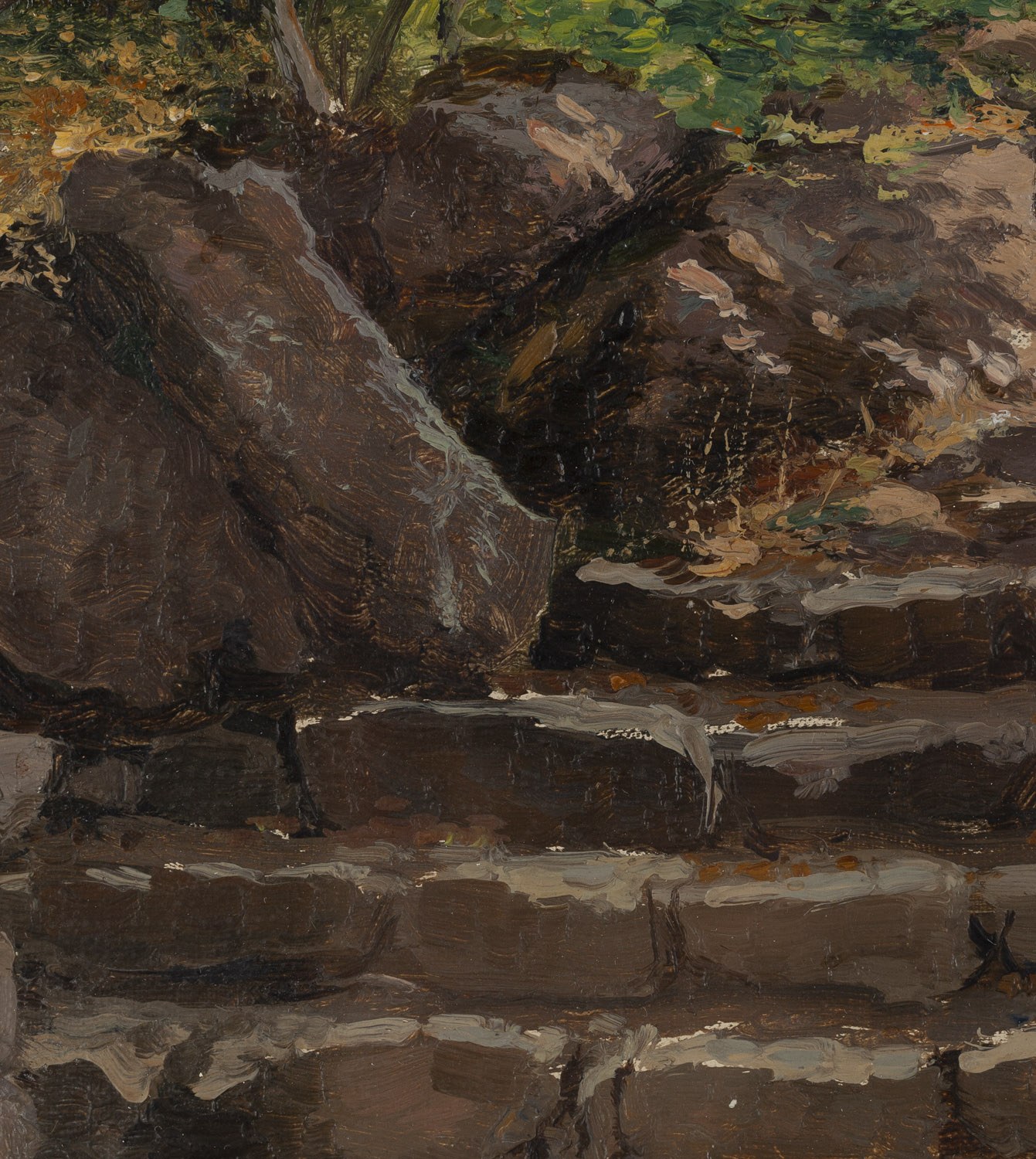
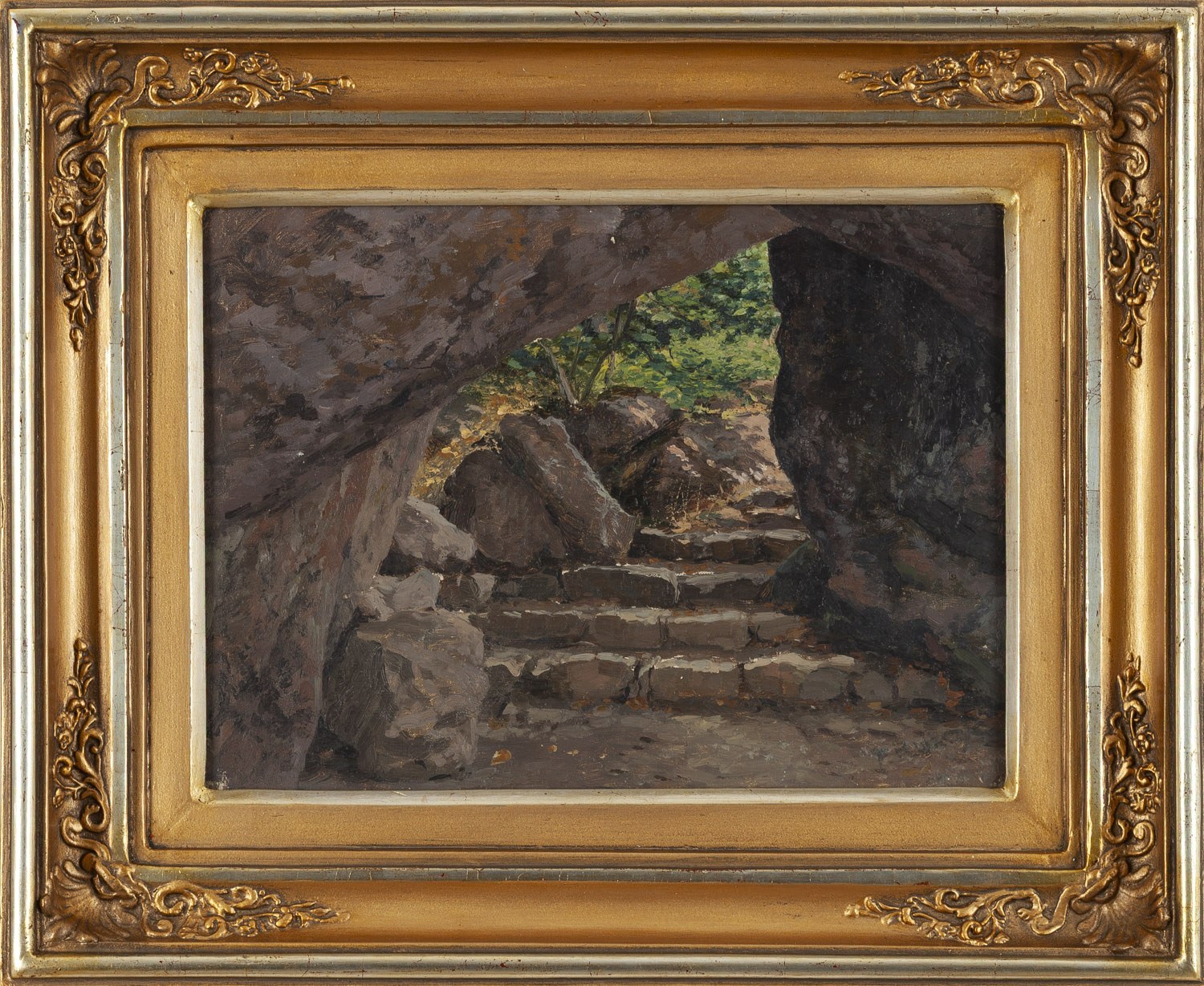
Dimensions: 23 x 31 cm
signed lower right: 'F. Ruszczyc'
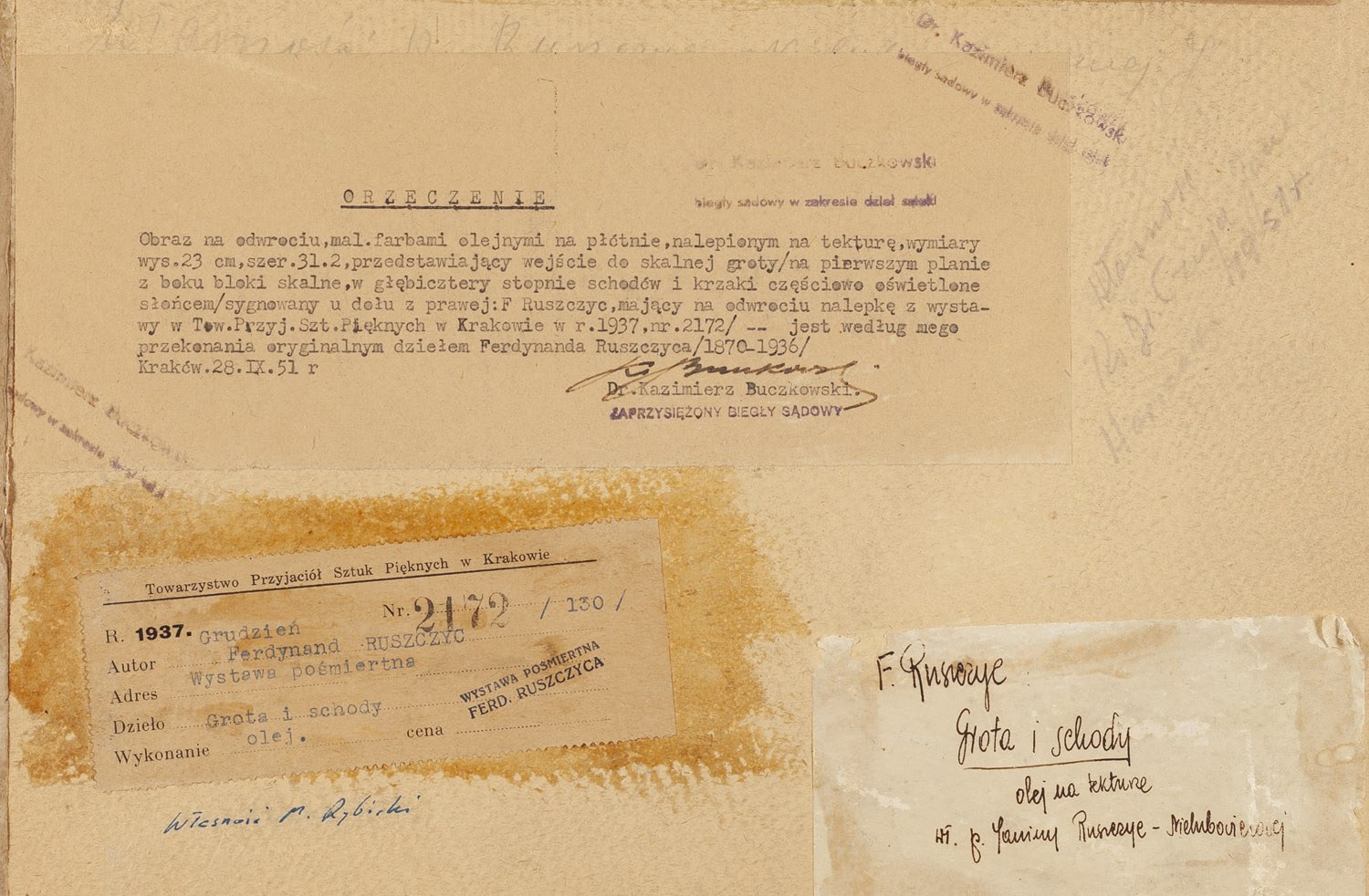
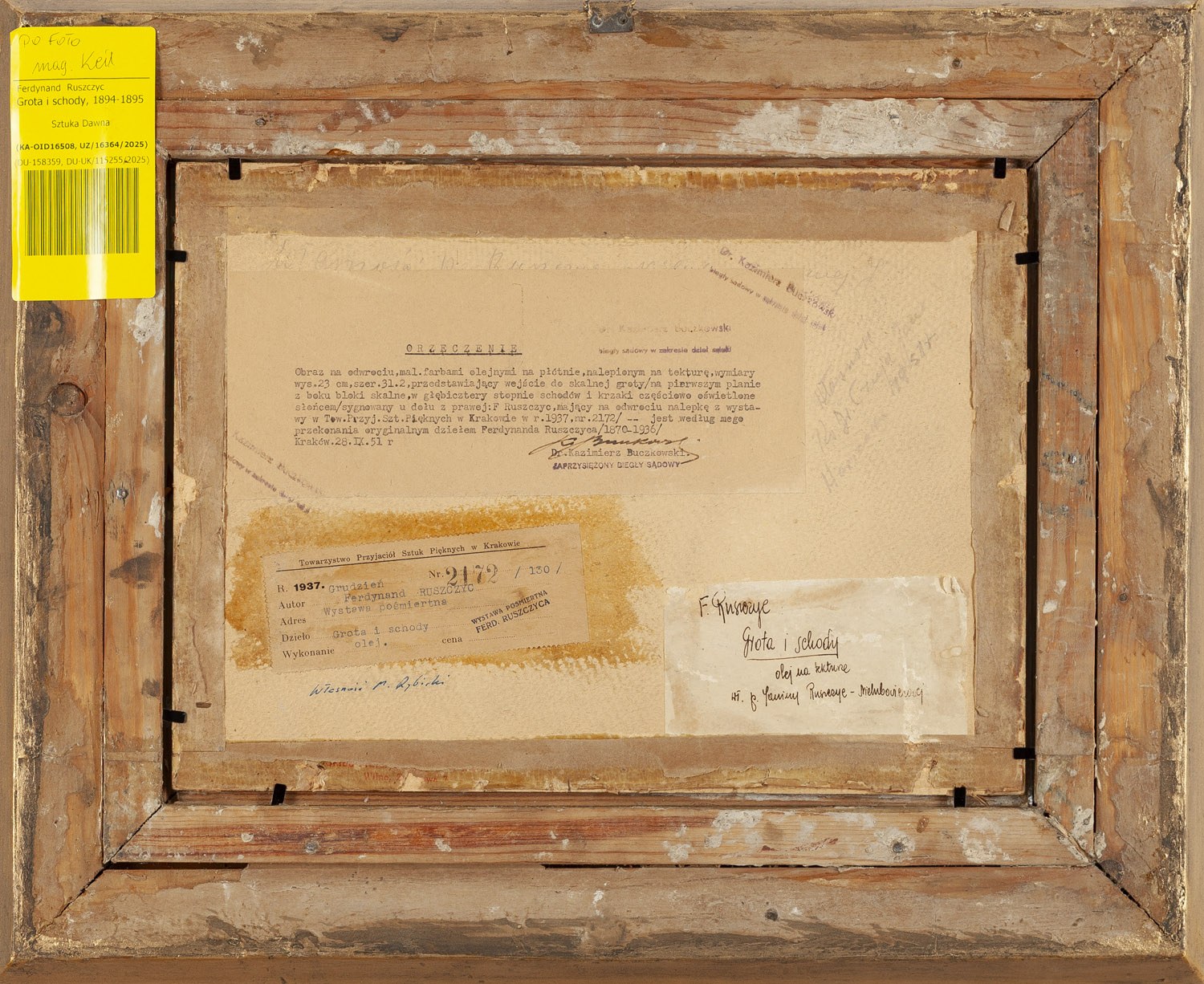
written in pencil on the reverse: 'Property of Mr. Ruszczyc [fragment under the inscription] wej J.' and 'Property | [...] Czuja Jan | Warsaw 1951' and in pen: 'Property of Mr. Rybicki', a paper ownership label inscribed in pen: 'F. Ruszczyc | Cave and Stairs | oil on cardboard | owned by Ms. Janina Ruszczyc-[...]', a paper exhibition label from the Society of Friends of the Fine Arts in Kraków, and an expert opinion by Dr. Kazimierz Buczkowski dated September 28, 1951
Provenance
the collection of the artist’s daughter, Janina Ruszczycówna (1914–1988)
private collection, Warsaw
Exhibited
Ferdynand Ruszczyc 1870–1936. Posthumous Exhibition, Society of Friends of the Fine Arts, Kraków, December 1937–January 1938
Ferdynand Ruszczyc 1870–1936, Society for the Encouragement of Fine Arts, Warsaw, November 20–December 14, 1937
Posthumous Exhibition of Paintings and Drawings by Ferdynand Ruszczyc, Vilnius, October 1937 (?)
Bibliography
Report of the Committee of the Society for the Encouragement of Fine Arts in Warsaw for 1937, Warsaw 1938, p. 47
Ferdynand Ruszczyc 1870–1936. Catalog of the posthumous exhibition, Society of Friends of Fine Arts in Kraków, Kraków 1937, cat. no. 130
Ferdynand Ruszczyc 1870–1936. Guide 127, Society for the Encouragement of Fine Arts in Warsaw, Warsaw 1937, p. 38, cat. no. 127
Catalog of the posthumous exhibition of paintings and drawings by Ferdynand Ruszczyc, Vilnius 1937 (?)
Biography
In 1890, he graduated with a gold medal from the classical gymnasium in Minsk, Lithuania, and began studying law in St. Petersburg. In 1892, he transferred to the St. Petersburg Academy of Fine Arts, where, beginning in 1897, he studied under Ivan Shishkin and Arkhip Kuindzhi. During his studies, he undertook several trips, including to the Crimea (1894 and 1895) and to Berlin and Sweden via Königsberg, Szczecin, and Rügen (1896). That same year, he settled in Bohdanów, from where he subsequently embarked on a grand tour of Europe (Germany, France, Belgium, Switzerland, and Italy). In 1903, he played an active role in organizing the Warsaw School of Fine Arts, where he served as a professor from 1904 to 1907. During the 1907–08 academic year, he was also a lecturer at the Academy of Fine Arts in Kraków. In 1908, he returned to the Vilnius region. He lived in Bohdanów and Vilnius. In 1918, he established the Faculty of Fine Arts at Stefan Batory University. He served as a professor in that faculty from 1919 to 1932. From 1900 onward, he was actively involved in the Polish Artists’ Society “Sztuka” (in 1907 he served as its president; together with Józef Mehoffer, he organized several of the Society’s exhibitions, including those in Vilnius (1903) and Vienna (1908). Ferdynand Ruszczyc was one of the most outstanding Polish painters of the Young Poland period. In addition to his numerous and diverse works across many fields, he is primarily associated with atmospheric landscapes characterized by a modernist style.