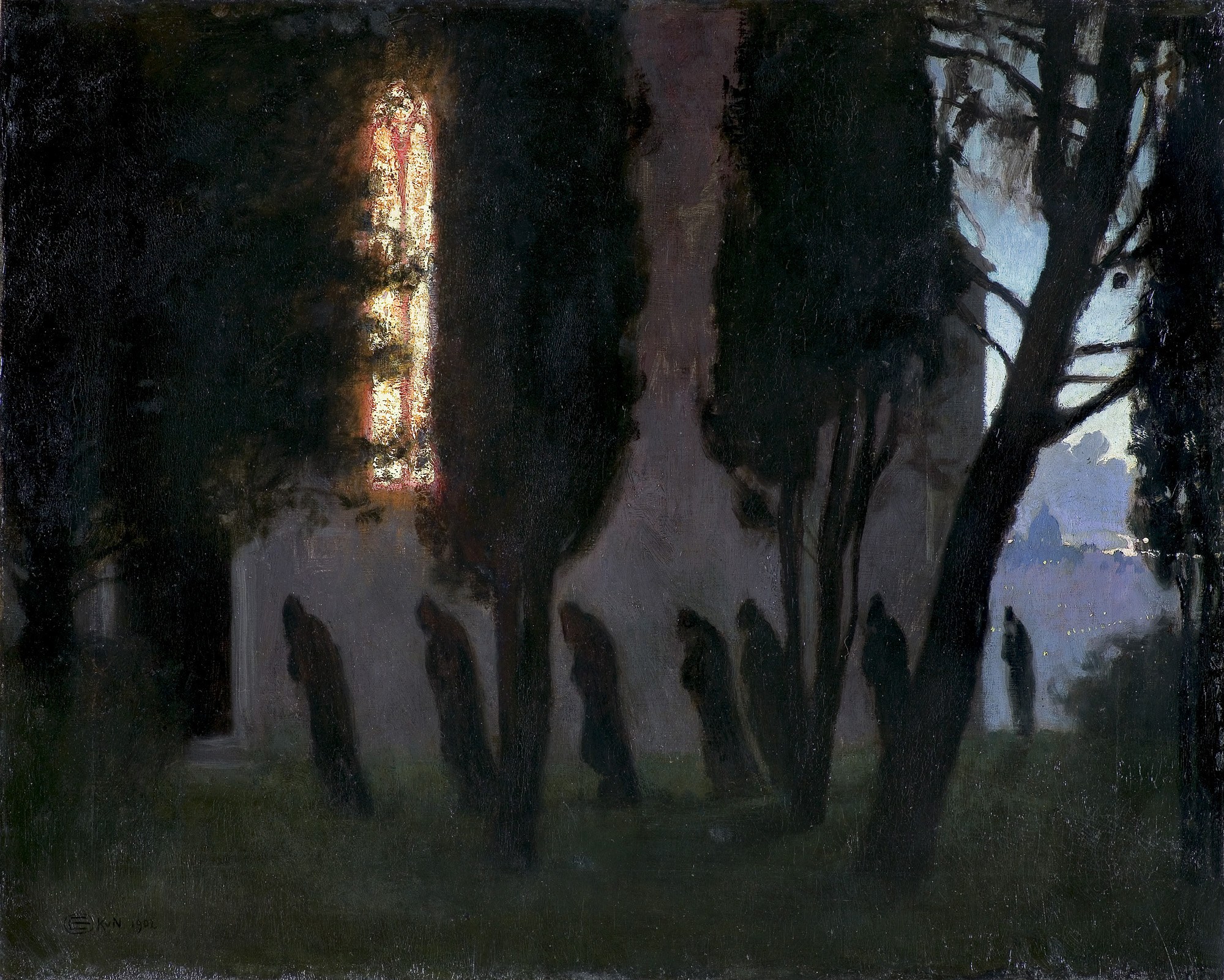
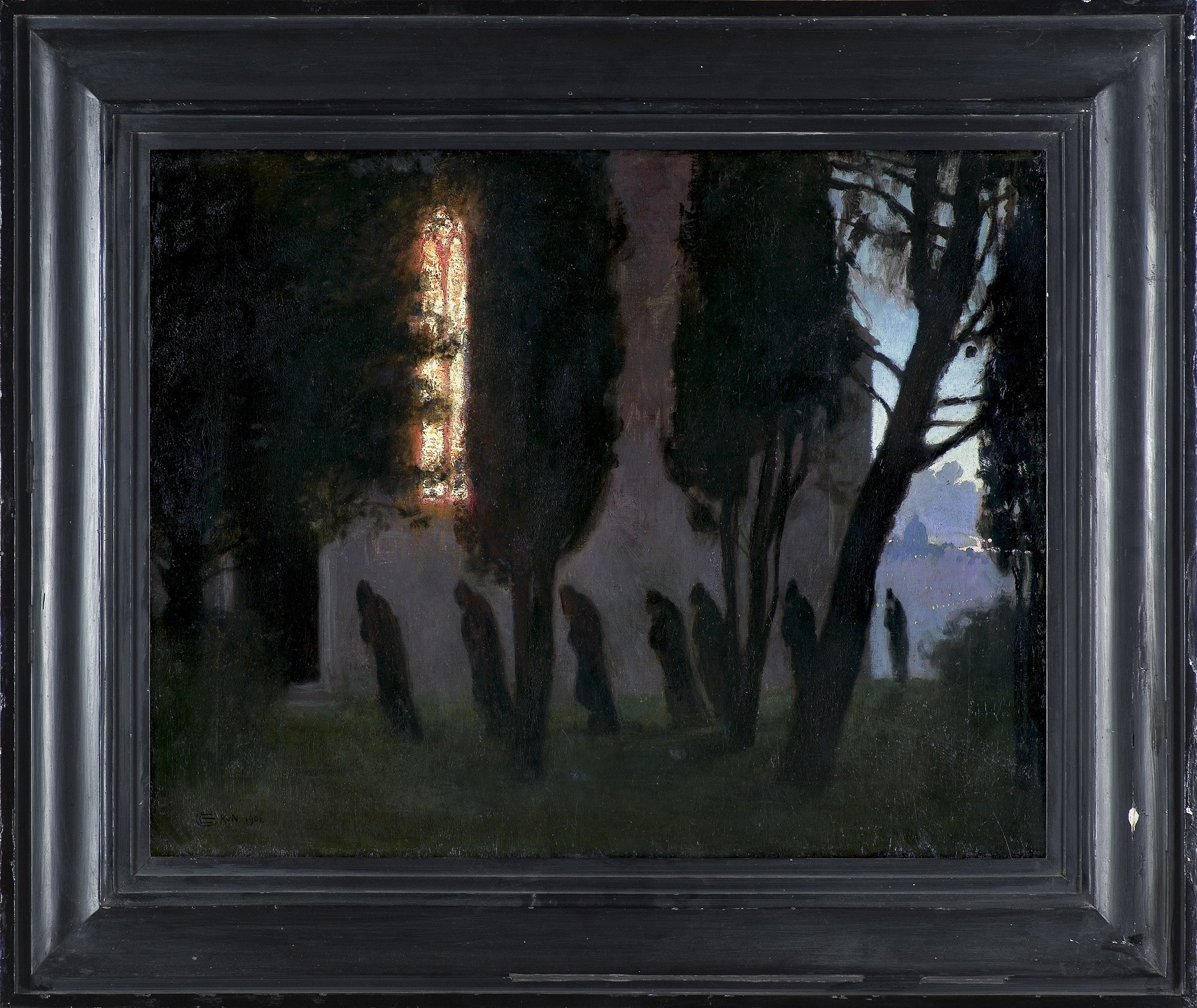
50,3 x 63,3cm - oil, canvas signed l.d.: EOKUŃ 1902 [initials tied].
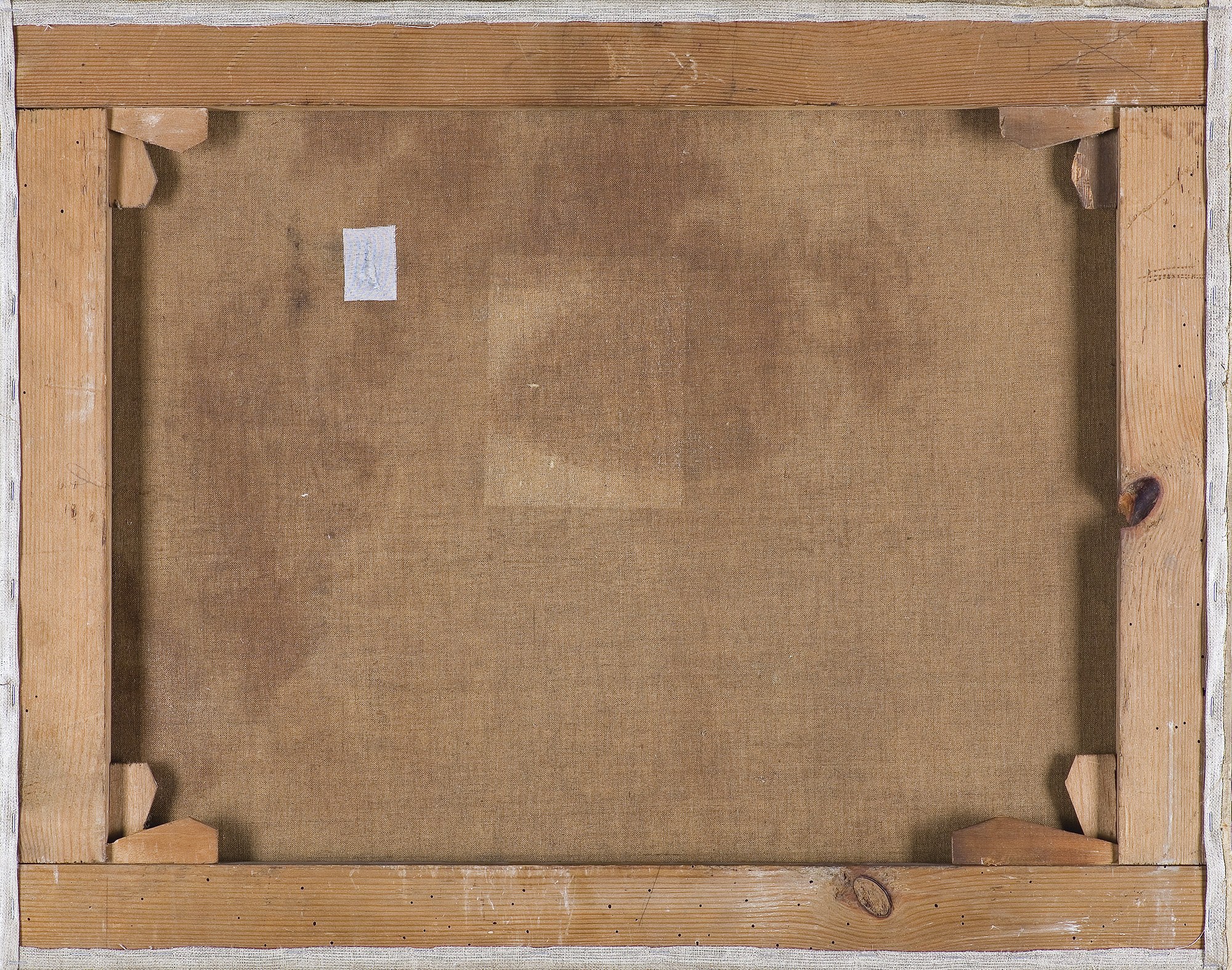
On the reverse centrally an ownership sticker with the Rawicz coat of arms, below (in ink): Okuń | Ave Marya; in addition, on the right frame strip, a sticker of the TZSP in the Kingdom of Poland (print, ink): No. 2142 | Author's surname Edward | Okuń | Type of oil work | Title Ave Marja | Size - | Price or its value 130 | Author's ownership | Address | Warsaw d. 2/15 X 902; in addition, on the top bar of the frame, a trace of a rectangular sticker
Provenance:
- Property of the artist 1902.
- 1902-1917 Property of Count Juliusz Karol Ostrowski - purchased from an exhibition at TZSP.
- Ownership of the heirs of the above.
- Purchased by Waclaw Konieczny (1882-1942) - entrepreneur and director of the ceramics factory in Poraj near Czestochowa.
- In the collection of the heirs of the above.
The painting exhibited and mentioned in:
- "Theater Courier," 1902 No. 31, p. 4;
- Report of the Committee of the TZSP in the Kingdom of Poland for the year 1902, Warsaw 1903, p. 5 (Ave Marja);
- Guide to the TZSP Exhibition No. 40, Warsaw 1929, p. 5, cat. no. 66 (Ave Maria);
- Report of the TZSP Committee in Warsaw, Warsaw 1930, p. nlb. (Ave Maria);
- Guide to TZSP Exhibition No. 138, Warsaw 1939, p. 8, cat. no. 63 (Ave Maria);
- J. Wiercińska, Catalogue of works exhibited at the TZSP in Warsaw in the years 1860-1914, Wrocław 1969, p. 255;
- M. Biernaca, Edward Franciszek Mateusz Okuń [in:] Słownik artystów polskich..., vol. 6 Warsaw 1998, p. 231;
- Małgorzata Biernacka, Literature - symbol - nature. The work of Edward Okuń vis-à-vis Young Poland and European symbolism, Warsaw 2004, pp. 203 and 298.
The first owner of the painting was Count Juliusz Ostrowski (1854-1917), who in 1902 purchased the work directly from Edward Okunia's exhibition at the Zachęta Gallery in Warsaw. This is evidenced by an entry in the Report of the Committee of the Society for the Encouragement of Fine Arts in the Kingdom of Poland for 1902.
Juliusz Karol Count Ostrowski (1854-1917) inherited the Ujezda estate from his father, making him one of the richest landowners in the Kingdom of Poland. He was a great enthusiast of heraldry of the old lands of the Republic of Poland, Silesia, Western Pomerania and Courland, which resulted in the volumes of The Book of Coats of Arms of Polish Families he published in 1896-1914. He was a Catholic activist, a Knight of Malta, one of the initiators and president of the Catholic Union. He also served as a papal chamberlain. As an ardent art enthusiast, he collected works by many artists, both Polish and foreign. He supported many young artists financially. In 1912 he was co-organizer of a large exhibition of Polish and foreign paintings in Tomaszow Mazowiecki. Almost half of the works on display at the time came from Count Ostrowski's collection. An inventory of Juliusz Count Ostrowski's collection of paintings in his apartment at 14a Piękna Street in Warsaw testifies to how rich these collections were. From this document we know that the featured painting was owned by the count until his death in 1917. In the collection's inventory it is listed under item no. 254 - Edward Okuń Ave Marja.
In January 1939, the painting was presented at Okuń's exhibition in Warsaw's Zachęta Gallery. The catalog lists the price for which the painting could be purchased at the time. Unfortunately, the outbreak of war caused the TZSP Report for 1939 not to be published, so there is no confirmation if and who purchased the painting from the exhibition. According to information provided by the current owner, it appears that the painting at an unspecified time before the war was purchased by Waclaw Konieczny (1882-1942) and has remained in the hands of his family and heirs until today.
Ave Maria is an excellent example of the artist's masterful handling of light. The mysterious scene, set in a Roman landscape shrouded in darkness, shows slender, hooded figures unhurriedly gliding toward the entrance to the chapel. The eye is drawn to a large Gothic window, from which beams a strong light spilling a soft pink glow over the church walls. In the background, ranks of lantern fires leading to St. Peter's Basilica are visible in the glow of the setting sun. This atmospheric image does not let you pass by indifferently. It entices the viewer with the intensity of the stained glass window, and then draws him in, slowly emerging details from the gloom.
Edward Okuń (Wólka Zerzyńska /now Zerzeńska/ near Warsaw 1872 - Skierniewice 1945) - painter, draughtsman, illustrator - began his artistic studies at the Warsaw Drawing Class under Wojciech Gerson. From 1891 to 1893 he studied at the School of Fine Arts in Cracow, including under Jan Matejko, and from 1893 in Munich under Anton Ažbe, Stanislaw Grocholski and Szymon Hollosy. He completed his studies in Paris. From 1898 he lived permanently in Italy - in Rome, and periodically in nearby Anticoli Corrado, Florence, Sorrento, Amalfi and Capri. In 1914 he traveled to Egypt. In 1921 he returned to Warsaw, where he was a professor at the School of Fine Arts from 1925 to 1930. He traveled to Italy several more times (including in 1928, 1937, 1938), and in 1927 and 1929-1932 he traveled to Yugoslavia, where he created a series of landscapes from the Adriatic Sea - "Jadran". He painted decorative, stylized portraits, idyllic landscapes and compositions with fantastic and fairy-tale themes, close to Symbolism and Art Nouveau. He often designed the frames for his paintings himself, treating them as an integral part of these works. He was an outstanding creator of book graphics; he made illustrations, vignettes, cover designs, initials and interludes, collaborating with the Warsaw magazine "Chimera" among others.





![Edward Okuń (1872 - 1945) , Ekslibris Towarzystwo Biblioteki Publicznej w Warszawie, Warszawa 1907 [ Syrenka, Ex libris, secesja ]](https://img1.one.bid/img/9385/2919371_1w.webp?1771716263)