


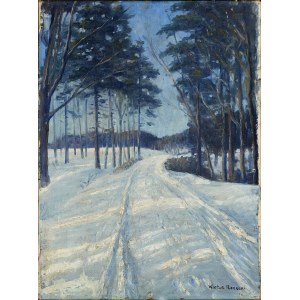
oil, canvas 58.5 x 43.5 cm
signature p.d.: 'Wiktor Korecki'
inventory number: UK/16/12/2019/c
ORIGIN:
private collection, Bielsko-Biala
Wiktor Korecki,
was one of the most prolific Polish landscape painters of the 20th century. His paintings are particularly valued for their unique mood, play of colors and light. The subject matter of his paintings reflects the tastes of the Polish middle class of the interwar years. He painted what was in demand - subjects known and loved from the classics of Polish painting at the turn of the 20th century: fishermen with nets known from the paintings of Wyczółkowski, wolves known from the paintings of Wierusz-Kowalski, meandering streams in winter, appreciated earlier in the works of Fałat, birches and pines on the moors - Rapacki's favorite subjects. He reproduced in minute detail images from his childhood spent in Podolia. A frequent subject of Koretsky's paintings was the motif of the sea painted at different times of the day. Koretsky is a genuine admirer of meadows, forests, streams, the sun, an observer of the countless metamorphoses they undergo under the influence of different qualities of light. These different atmospheres created by light he is able to render with mastery. His landscapes let the viewer feel almost physically the atmosphere of the place, its temperature, the time of day. Korecki was an extremely prolific painter. In the 1960s and 1970s, he usually painted a picture every two days, which amounted to 15 paintings a month. The speed of painting at that time was due to his routine, but one can't help but think of his phenomenal memory, thanks to which the paintings didn't have to be created outdoors.
Viktor Koretsky's works are in private collections: in America, Russia, Ukraine, Sweden, Austria and Mexico, as well as in museum collections: Museum of Hunting and Riding in Warsaw and the Museum of Southern Moravia in Znojmo. He even painted on commissions from Africa.
Viktor Koretsky was born on June 30, 1897 in Kamieniec Podolski. He attended the Kyiv Gymnasium and then the drawing school there. In 1921 he settled in Warsaw and soon gained a reputation as a good landscape painter. Between the wars he participated in three group exhibitions of the Society for the Encouragement of Fine Arts. After the outbreak of the Warsaw Uprising, along with thousands of Warsaw residents, he was deported to Germany, where he was sent to a labor camp in Leipzig. After escaping from the camp, he spent almost two years in Moravia in the Czech Republic. From there he returned to Poland and settled in Milanowek near Warsaw. In 1966 he moved to Komorów. He died in 1980.
[Based on a study by Piotr Chwedorowicz, author of an exhibition on Wiktor Korecki].










हाल ही में देखी गई
लॉट लिस्ट देखने के लिए कृपया लॉग इन करें
पसंदीदा
लॉट लिस्ट देखने के लिए कृपया लॉग इन करें