


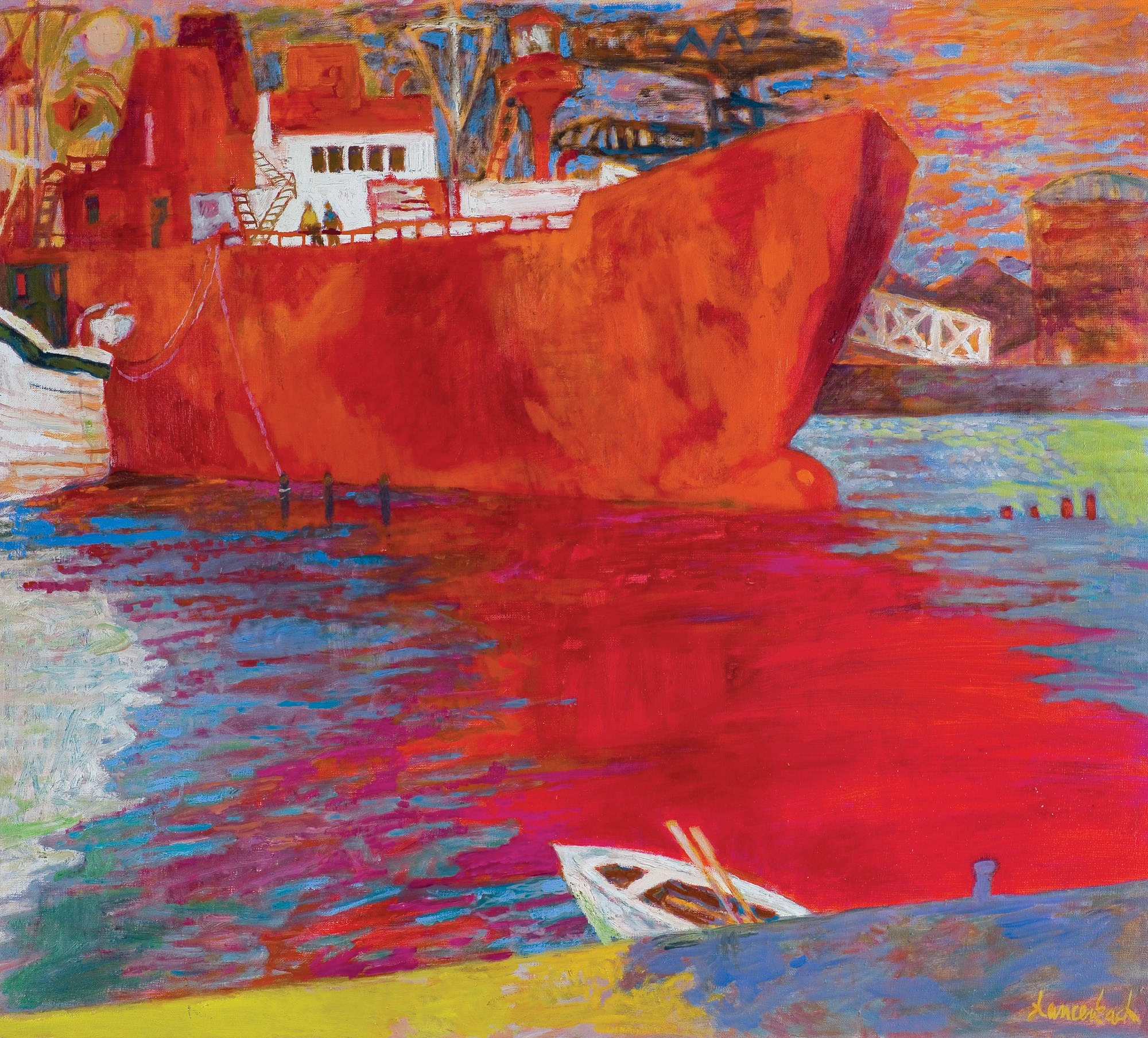
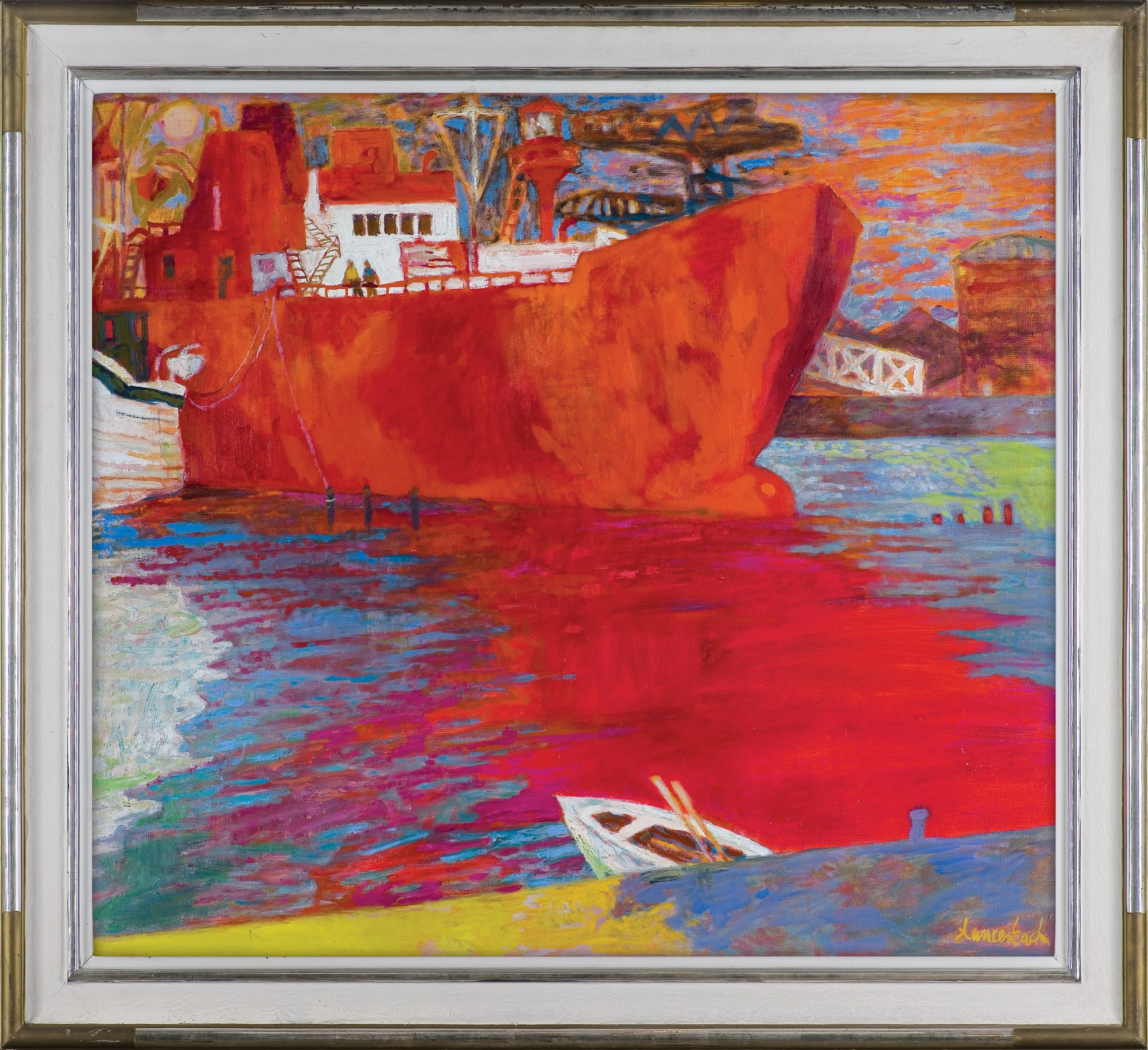
85.5 x 96.0 cm - oil, canvas
sign. p.d.: Szancenbach
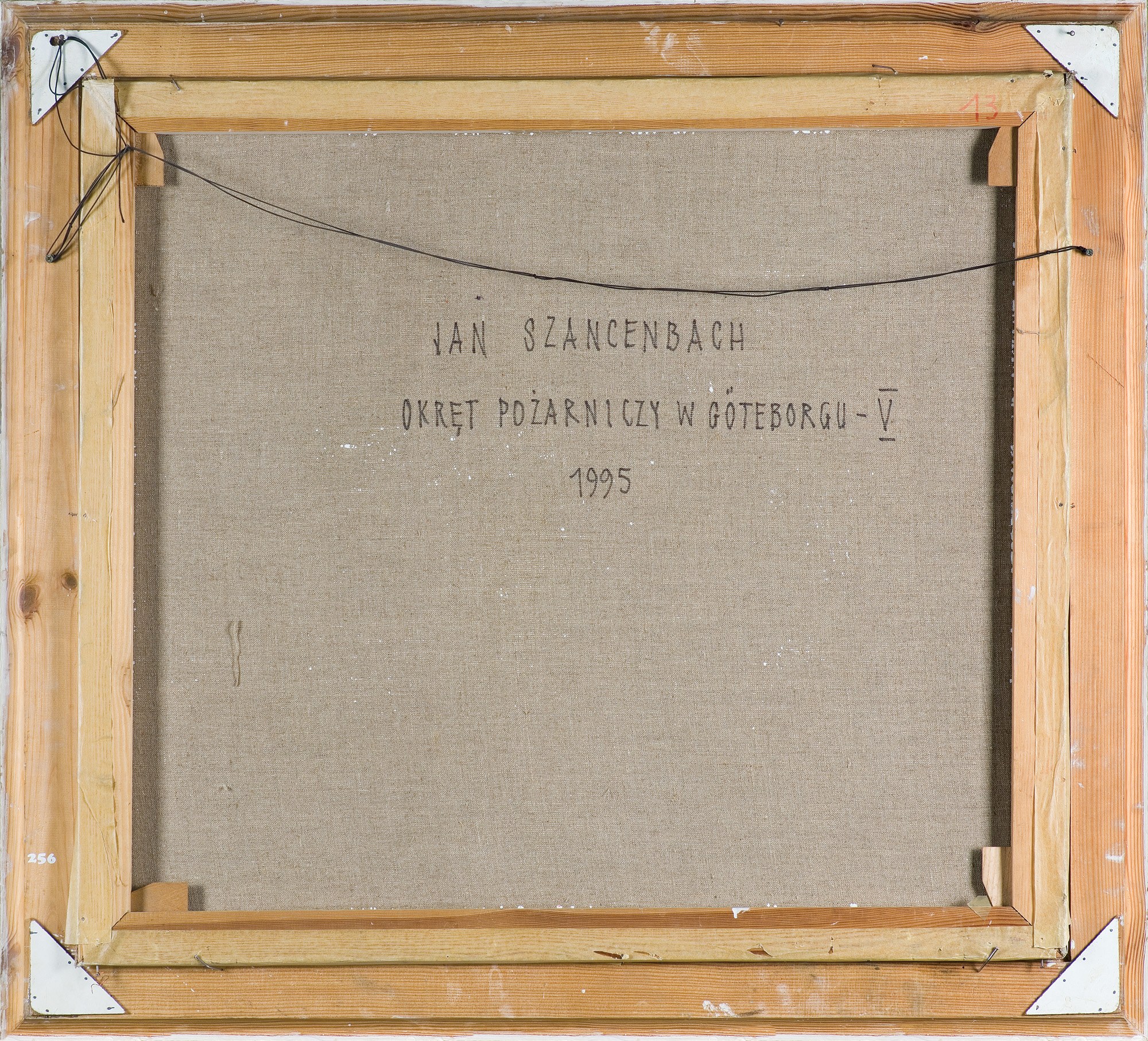
Sign. on the reverse: JAN SZANCENBACH | OKRĘT POŻARNICZY W GÖTEBORG - V | 1995
Image exhibited and reproduced:
- Jan Szancenbach. Painting (exhibition catalog), Art & Business Club, ABC Gallery, Poznań XI 1996, p. 32, color ill. no. 27, cat. no. 19;
- Jacek Malczewski, Czesław Rzepiński, Juliusz Joniak, Jan Szancenbach. Painting. Exhibition from the Collections of the Cracow Rotarians and their Families and Exhibition "The Szancenbachs: Jan, Maria and Krystyna" from the Private Collection of Professor Jan Szancenbach, Palace of Art in Cracow TPSP, 19 - 27 X 1996 and III - V 1999, Cracow 1999, unnumbered pages and illustrations;
- Jan Szancenbach, Municipal Art Gallery "MM", Chorzow, 31 May - 28 June 2004 (rep. on a postcard issued on the occasion of the exhibition).
This is one of a larger series of paintings depicting fire ships standing in the port of Gothenburg, or perhaps rather the so-called "lighthouse ships." These ships, acting as a lighthouse or other beacon, are classified as a floating beacon. Mostly they were unpowered, permanently anchored in a place where the construction of a lighthouse is impossible. They were painted bright red so that they could be clearly visible at sea. Nowadays, they are encountered less and less frequently, replaced by luminous buoys.
♣ A fee will be added to the auctioned price in addition to other costs, based on the right of the creator and his heirs to receive remuneration in accordance with the Law of February 4, 1994 - on Copyright and Related Rights (droit de suite).
Jan Szancenbach (Krakow 1928 - Krakow 1998) studied from 1940 to 1942 at the Kunstgewerbeschule (i.e. the Academy of Fine Arts relegated by the occupying forces to the role of a vocational school) under Stanislaw Kamocki, Jozef Mehoffer, Andrzej Jurkiewicz, among others. After the academy was closed, he worked for a living and studied independently from 1942 to 1945. In 1945 he was re-admitted to the second year of his studies, which he completed under the direction of Eugeniusz Eibisch in 1948 (he received his diploma in 1952). From 1948 he worked as an assistant in his home studio and in Ludwik Gardowski's studio of lettering and graphic design. He progressed through all levels of his academic career, from assistant to full professor (since 1986). Since 1972 he held his own chair at the Faculty of Painting. From 1987 to 1993 he served two terms as rector of the Academy of Fine Arts in Cracow. As a painter, he remained faithful to the school of Polish Colorism, the principles of which he assimilated during his studies with Eibisch. His painting is full of light and saturated colors, joyful, even feverish. In addition to outstanding color qualities (especially in reds, the painter achieved an extraordinary scale of varieties and shades), he does not shy away from decorativism, which together make up a hedonistic, carefree expression. Known primarily as a creator of still lifes, landscapes, and garden scenes, Szancenbach was also involved in monumental painting. Among other things, he worked on the renovation of the Słowacki Theater in Cracow and the auditorium and plafond of the Wrocław Opera House. Another strand of his art was graphic design (trademarks, posters, covers, packaging, labels, postage stamps, etc.), and he was also involved in book illustration and cartoon film.













हाल ही में देखी गई
लॉट लिस्ट देखने के लिए कृपया लॉग इन करें
पसंदीदा
लॉट लिस्ट देखने के लिए कृपया लॉग इन करें