


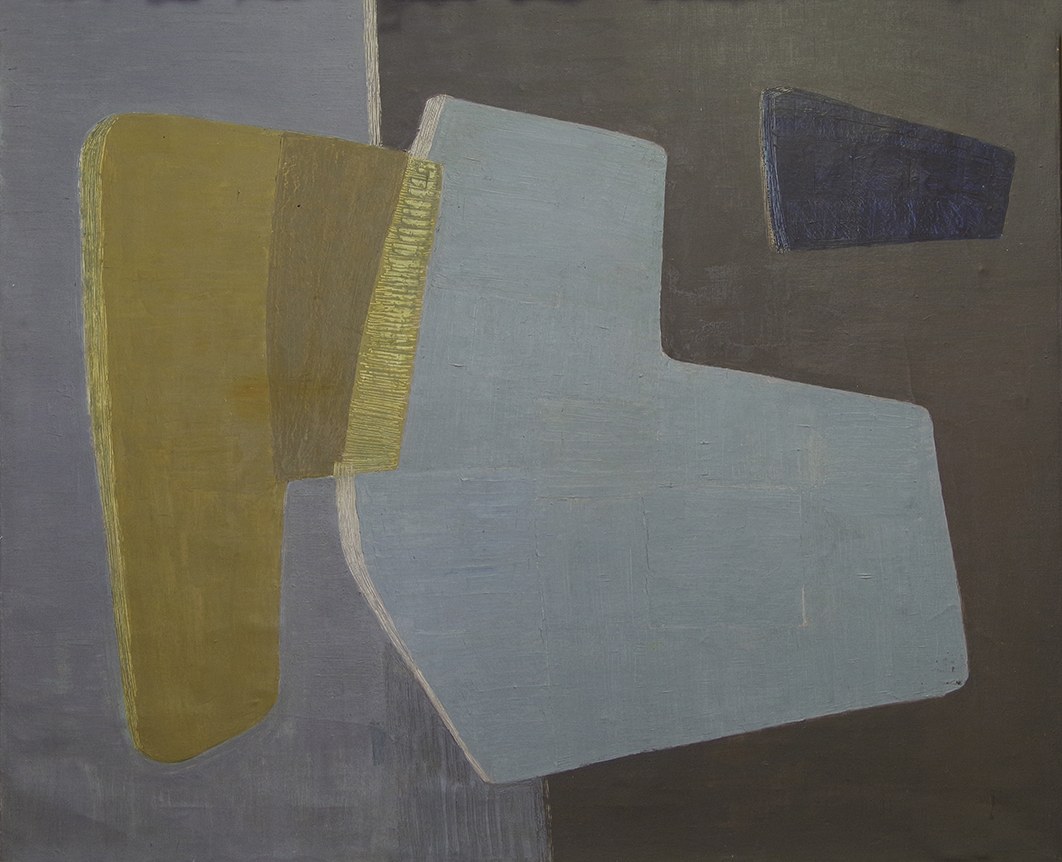
oil/canvas, 83 x 102 cm
signed, dated and described on the back: 'KRZETUSKA | FORMS 2/67 | ol/ł | 83 x 102
Hanna Krzetuska studied at the Ludwika Mehoffer Free School of Painting and Drawing in Cracow from 1920 to 1924 with Jerzy Fedkowicz, Zbigniew Pronaszko and Jan Rubczak . She also graduated from the Higher Courses for Women. In 1925 she left for several months of art studies in Paris. Since 1926, she was a member of the Association of Visual Artists, and since 1937 of the Association of Visual Artists "Zwornik" in Cracow. During World War II, she was active in the underground under the pseudonym "Shine."
After arriving in Wroclaw, she worked at the State Higher School of Visual Arts from 1948 to 1960. Intellectual and cultural family traditions on the one hand and thorough education on the other hand meant that Hanna Krzetuska was able not only, together with her husband, Eugeniusz Geppert, to take up the challenge of organizing the Higher School of Fine Arts - (later Eugeniusz Geppert Academy of Fine Arts) but also significantly influenced the formation of artistic life in Wroclaw. Since 1961, she co-founded the Wroclaw Group, which included such prominent artists as Wanda Golkowska, Jan Jaromir Aleksiun and Konrad Jarodzki . Moving out of Cracow and traveling to the so-called Recovered Territories was only possible thanks to the joint work and similar artistic goals of both artists. Hanna Krzetuska, highly praised today by critics for her original, consistent painting program, also supported the work of Eugeniusz Geppert. After his death, in their shared studio she led to the establishment of the contemporary art gallery Geppert's Apartment, run today by the Art Transparent Foundation.
Shaped in the spirit of colorism, she remained faithful for a long time to the tradition based on the painting values postulated by the Capists. A change in her way of painting occurred in the 1960s, when she turned to abstraction, primarily geometric. She began to build her compositions by juxtaposing large planes of color, framed in geometric forms, and exploring the relationships between them. "A painting has to play, although it doesn't even make any murmur," she - she said. It is precisely this "play," with the scale and rhythm of geometric forms despite their irregular shapes - that gives her paintings an impression of harmony, close to musical compositions.










हाल ही में देखी गई
लॉट लिस्ट देखने के लिए कृपया लॉग इन करें
पसंदीदा
लॉट लिस्ट देखने के लिए कृपया लॉग इन करें