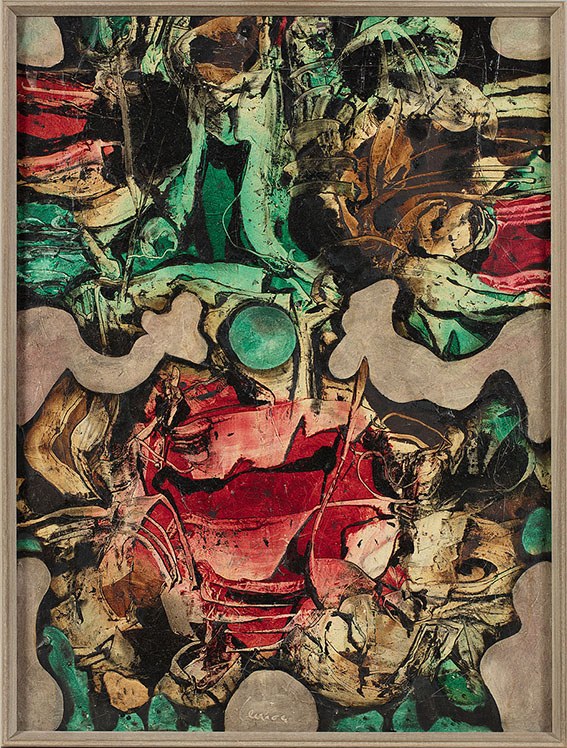

Dimensions: 92 x 69 cm
Signature: signed at the bottom of the composition: lenica, signed and inscribed on the reverse: A. LENICA / WARSAW / 1960 - 68 / 69 x 93 (oil - tempera) / "CZERWONE UMOCNIENIA" and a mounting indication
Provenance
Poland, Desa Unicum private collection, 25.05.2023, item 11 Poland, Uppsala private collection, Uppsala Aukctions Kammare, auction 14.06.2019, item 623 Sweden, private collection
Alfred Lenica is one of the most important artists of the Polish avant-garde of the 20th century, a professional violinist by training, who, like many outstanding contemporary artists, studied painting outside the academic canon. He wrote: "music made it easier for me to learn about color and sound" (Gawrońska-Oramus B., Alfred Lenica, published by BOSZ, Olszanica 2016, p. 4). In the pre-war years, his painting technique focused on the themes of landscape, portrait and still life. In the postwar period, he began the process of searching for and shaping his individual style.
A decisive influence on the shape of this search was Lenica's displacement with his family from Poznan to Krakow, where the artist entered the circle of young artists associated with Tadeusz Kantor. Meeting them proved to be very inspiring - Lenica then undertook a number of experiments within the realm of abstract painting. These explorations were disrupted by the brief Socialist Realist period. However, as early as the second half of the 1950s, Lenica returned to his precursor activities in the circle of informel art. He used the dripping technique with increasing frequency. This, combined with his feel for Surrealist art, allowed him to develop a distinctive style around 1958, based on swirling, colorful patches, sometimes bordered by an outline, which dynamically fill the fields of paintings. Painted in oil paint, the freely spaced colorful forms were covered with a network of thin lines made with flowing varnish. "(...) Lenica was connected with Tashism painting by the ever-present moment of accepted and even programmed chance, with gesture painting - the 'graphological' trace of the movement of the hand guiding the tool along the surface of the canvas. With surrealism - a spontaneous, automatic record of mental states (...) and this connection seems fundamental. For when the latter only touch on the method and technique of action - this one defines the attitude of the artist" (Kowalska B., Catalogue of Lenica's exhibition at Gallery 72).
In Lenica's paintings one can often feel the reference to natural forms, which is why his paintings were often called biological painting. The artist executed them in a manner similar to the creation of surreal decalcomania, and over time turned it into his own technique, which became his trademark. The earliest works from this trend, presented at the painter's first solo exhibition at Warsaw's Zachęta Gallery in 1958, made Lenica an icon of Polish Tascist painting.